



























Editor's Note
At a Glance
-
Distinct spheres, shared life
While society can be understood in terms of distinct spheres—such as church, family, work, and governance—these are not isolated domains. They are interrelated and continually shaping one another within the whole of human life, while no sphere is sovereign over another. This is also called sphere sovereignty. -
Whole-person discipleship across every sphere
Individuals do not live fragmented lives but as integrated persons, carrying their faith, identity, and calling into every context—reflecting the call to follow Christ in all of life. -
An interconnected social reality
Culture, technology, power, and knowledge move across all spheres, influencing how people live, lead, and relate. These shared realities highlight the need for biblically grounded discernment in every area of society. -
Mission in every sphere of society
In light of this interconnected world, the mission of God is not confined to the church alone. It is lived out through the whole church, bringing the whole gospel to the whole world—expressed through faithful presence and witness in every sphere of society.
Interpenetrating Spheres and Interrelated Integration

Classical neo-Calvinist articulations of sphere sovereignty have provided an important corrective to ecclesial overreach and state absolutism by affirming the relative integrity and distinct responsibilities of social spheres.1
These articulations rightly resist institutional domination and preserve the differentiated callings of family, church, state, economy, and other domains of social life.2
At the same time, they are often rendered in static and two-dimensional terms, portraying spheres as side-by-side domains with clearly bounded jurisdictions.3 However, this interpenetrating framework addresses these static renderings by recognizing that while these ‘territories’ possess distinct jurisdictional logic, they are not hermetically sealed. Instead, they exist in a state of substantive interpenetration.
they are not hermetically sealed. Instead, they exist in a state of substantive interpenetration.
Furthermore, this paradigm identifies human agency as the indivisible bridge across institutional thresholds; while the agent’s functional roles adapt to jurisdictional requirements, the person carries a coherent ontological unity; they carry a unified supra-identity — governed by higher-order contingencies — that does not merely occupy a sphere but actively permeates every sphere of activity.
Human beings do not inhabit spheres discretely, as though moving between sealed domains. Rather, they live simultaneously within multiple spheres at once, carrying moral, epistemic, relational, cultural, and spiritual dimensions across contexts. Family life, economic activity, education, political participation, and ecclesial belonging are not compartmentalized experiences but interwoven realities.
Family life, economic activity, education, political participation, and ecclesial belonging are not compartmentalized experiences but interwoven realities.
Moreover, culture — understood as the shared patterns of meaning, practice, communication, and normativity through which life is interpreted and enacted — is a cross-spherical and interpenetrating reality that reshapes the internal tendencies of each domain as it moves through them.4 As cultural conditions shift, the tendencies embedded within each sphere are reshaped, expanded, refined, or reconfigured over time. As a result, spheres do not merely coexist alongside one another; they intersect, overlap, and interpenetrate in concrete and ongoing ways.
This interpenetration occurs as structural and functional regions, along with shared cultural elements, move across boundaries, though the human person remains a central locus of convergence. Spheres themselves are interrelated structurally and functionally rather than operating as isolated systems.5 For instance, education is shaped by political regulation, economic pressures, cultural narratives, technological mediation, and moral norms. Family life is influenced by legal frameworks, labor expectations, digital technologies, and religious meaning.
Spheres themselves are interrelated structurally and functionally rather than operating as isolated systems.
Ecclesial practices are shaped by language, power relations, social imaginaries, and media environments. These intersections are not accidental incursions or boundary violations; they are inherent to the interconnected structure of social life within the created order.
spheres should not be imagined as rigid territories separated by impermeable borders, but as interrelated domains
Accordingly, spheres should not be imagined as rigid territories separated by impermeable borders, but as interrelated domains marked by distinction without isolation. Their integrity is preserved not through insulation but through proper orientation and accountable interaction. Additionally, interpenetration does not negate sphere distinction; rather, it renders those distinctions intelligible within an interconnected reality, rather than treating them as isolated or siloed systems.
Why Non-Overlapping Models Prove Descriptively and Structurally Insufficient
Models that treat spheres as strictly non-overlapping or functionally sealed struggle to describe how social life actually operates. While such approaches aim to prevent illegitimate encroachment, they often rely on an abstracted institutional logic that does not correspond to lived reality. In practice, spheres cannot remain isolated because the activities that constitute them are enacted by human beings operating within shared social, cultural, and material conditions.
Rather than producing holistic integration, this move frequently results in fragmentation and functional segregation
When spheres are treated as non-overlapping, integration is often relocated entirely into the private conscience of the individual. The person is expected to internally reconcile faith, ethics, and meaning while public institutions are treated as normatively neutral. Rather than producing holistic integration, this move frequently results in fragmentation and functional segregation, as individuals are implicitly discouraged from connecting domains of life in meaningful and coherent ways.
The problem, therefore, is not that spheres intersect, but that prevailing models lack the conceptual resources to account for intersection
Moreover, non-overlapping models fail to account for how authority, meaning, and responsibility are exercised across institutional boundaries. Economic practices shape family rhythms; political decisions structure educational possibilities; technological systems reshape communication within churches; cultural narratives frame moral imagination across all domains. These influences are not external intrusions but constitutive forces. The problem, therefore, is not that spheres intersect, but that prevailing models lack the conceptual resources to account for intersection without collapsing into either institutional dominance or functional dualism — the practical separation of meaning, value, and responsibility across domains of life.6
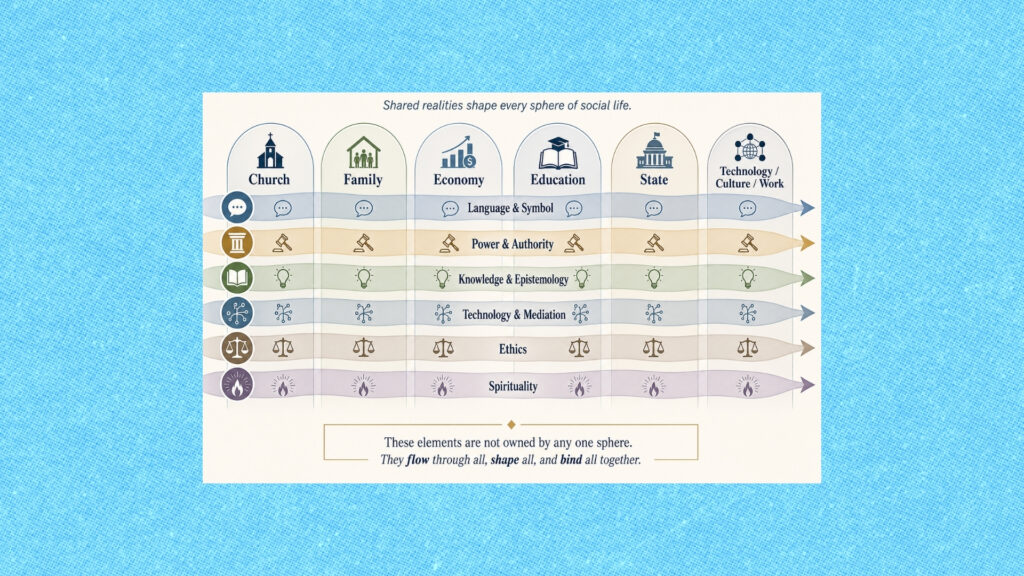
The Reality of Cross-Spherical Elements
Beyond the spheres themselves, certain realities are not owned by any single domain but operate across all of them. These include language and symbol, power and authority, knowledge and epistemology, technology and mediation, ethics, and spirituality.
Since human beings are meaning-making, moral, and relational creatures sustained by God, these elements remain operative even when a sphere claims autonomy or neutrality. They function as shared elements of social life, shaping how each domain functions internally and how it relates to the broader created order.
When spheres fail to recognize these interpenetrating elements, neutrality and autonomy cannot be sustained; they become distorted, interpreting reality through truncated internal logics. For example, an economic system operating in isolation reduces the human person to a mere “resource” — valuing efficiency over the moral and human dignity inherent in the worker. Similarly, a technological system prioritized as a sealed domain elevates capability over wisdom, ignoring the relational and ethical consequences of its mediation.
Recognizing interpenetration restores clarity by situating each sphere’s internal logic within the broader relational order of creation — preserving essential distinction while resisting the reductionism of modern “siloed” thinking.
Implications for Missional Integration and Conclusion
This interpenetrating, multilayered account of social life provides a necessary foundation for relational and missional integration. If spheres intersect and shared realities permeate them all, discipleship, formation, and mission cannot be confined to an institutionalized church domain, nor can it be reduced to the activities of parachurch or mission organizations. Rather, mission indeed does and must penetrate into all spheres more actively with this realization.
Mission is enacted across interpenetrating domains as persons and communities live faithfully under the lordship of Christ within family, work, education, culture, technology, and public life.
Such delineation clarifies that mission must be intentionally cultivated across multiple spheres, drawing on shared elements and contingencies in shaping missional discernment, planning, strategy, and lived practice across domains often treated as functionally separate.
Mission is enacted across interpenetrating domains as persons and communities live faithfully under the lordship of Christ within family, work, education, culture, technology, and public life.
This account does not collapse spheres into one another, nor does it imply comprehensive transformation in the present age. Instead, it articulates a faithful, integrative posture in which the authority of Christ is borne witness across the full scope of human life, even as the church awaits the final consummation of all things (Phil. 3:20–21; Heb. 9:28; Rev. 21:5).
Bibliography
- Costa, Renato Saeger Magalhães. “A Sphere Sovereignty Theory of the State: Looking Back and Looking Forward.” International and Public Affairs 3, no. 1 (2019): 13–18.
- Dooyeweerd, Herman. A New Critique of Theoretical Thought. Vol. 3. Translated by David H. Freeman and H. De Jongste. Ontario, Canada: Paideia Press, 1984.
- Kuyper, Abraham. Sphere Sovereignty. West Linn, OR: Monergism Books, 2024.
- Newbigin, Lesslie. The Gospel in a Pluralist Society. Grand Rapids, MI: Wm. B. Eerdmans, 1989.
- Un, Antonius Steven. “Sphere Sovereignty according to Kuyper.” Unio Cum Christo 6, no. 2 (October 2020): 97–114.Wan, Enoch. “The Paradigm of ‘Relational Realism’.” Occasional Bulletin of the Evangelical Missiological Society 19, no. 2 (Spring 2006): 1–4.
Endnotes
- Abraham Kuyper, Sphere Sovereignty (West Linn, OR: Monergism Books, 2024).
- Antonius Steven Un, “Sphere Sovereignty according to Kuyper,” Unio Cum Christo 6, no. 2 (October 2020): 99, 103.
- Herman Dooyeweerd, A New Critique of Theoretical Thought, vol. 3, trans. David H. Freeman and H. De Jongste (Ontario, Canada: Paideia Press, 1984), 349. Dooyeweerd acknowledges a “close interweaving of heterogeneous structural principles” as being “essential” to certain social units; however, his logic is designed to preclude a fusion of internal structural principles—thereby protecting institutional autonomy. This framework identifies a substantive interpenetration where distinct domains overlap within the lived reality of the human agent. See also Renato Saeger Magalhães Costa, “A Sphere Sovereignty Theory of the State: Looking Back and Looking Forward,” International and Public Affairs 3, no. 1 (2019): 15–16.
- For a discussion on the necessity of a relational paradigm in missiology to move beyond Western “compartmentalization,” see Enoch Wan, “The Paradigm of ‘Relational Realism’,” Occasional Bulletin of the Evangelical Missiological Society 19, no. 2 (Spring 2006): 1–4. While Wan correctly identifies the relational interconnectedness of reality, this framework extends that logic by specifically mapping the substantive interpenetration of social spheres based on their inherent ontological interpenetrating realities and facilitated through the ontological unity of the human agent.
- This structural and functional interrelatedness is grounded in the biblical witness of a singular, cohesive created order. Hebrews 1:3 (ESV) declares that Christ “upholds the universe by the word of his power,” implying that no domain of reality exists in autonomy or isolation from His sustaining word. This is further rooted in the creation order of Genesis 1–2, where God establishes distinct “domains” (e.g., the land, the seas, the heavens) and assigns them specific “functions” (e.g., bearing fruit, swarming with life, and marking seasons) that are intrinsically interdependent. A primary example of this is Genesis 2:5, where the “structure” of the ground and the “function” of human labor are interwoven: “there was no man to work the ground.” This demonstrates that social and material structures are designed by God to function as an integrated whole rather than as autonomous, non-overlapping systems.
- For more on functional dualism, see Lesslie Newbigin, The Gospel in a Pluralist Society (Grand Rapids, MI: Wm. B. Eerdmans, 1989), chapter 1. Newbigin critiques the modern “fact-value” dichotomy, where public institutions are treated as spheres of objective “fact” while moral meaning is relegated to the private realm of “values.” This framework identifies such dichotomization as a reductionistic distortion of social reality; instead, it maintains that meaning, value, and responsibility are interwoven and interpenetrating throughout the spheres as parts of existing reality and held integratively within the whole person.