


























Editor's Note
The biblical festivals are not only central to Jewish life and identity, but they also serve as windows into God’s redemptive plan for the nations. At a time when Jewish–Christian relations are often marked by tension and misunderstanding, the global church is called to build bridges of understanding, love, and witness.
This new series explores the holidays of world religions to help us understand and engage meaningfully and missionally with our neighbours of other beliefs in practical ways. In this series, we uncover what we can learn from these festivals that can enrich our biblical understanding, discipleship, and mission. Each article invites the church to deepen faith, reach out to religious communities with humility and love, and participate in God’s reconciling mission to the world.
Hanukkah, Jesus, and the Light of the World
Most Christians are surprised to learn that Hanukkah, the Jewish Festival of Dedication, appears in the New Testament. Though it was not commanded in the Torah like Passover or the Feast of Tabernacles, Scripture tells us that Jesus himself celebrated this holiday as he was at the Temple during this feast:
‘At that time the Feast of Dedication took place at Jerusalem. It was winter, and Jesus was walking in the temple, in the colonnade of Solomon’ (John 10:22-23).
You have to wonder, why would John make a point of telling us this? More than that, why did Jesus choose an otherwise lesser-known holiday to reveal some of his boldest claims about his identity?
To grasp the significance, we need to understand the story behind Hanukkah itself. Only then can we see how Jesus used this festival to illuminate the truth of the gospel.
How Hanukkah Came About
The events of Hanukkah take us back to about 165 BC, during the turbulent years between the Old and New Testaments. At the time, a Greek king named Antiochus IV Epiphanes ruled over Judea. He was determined to erase Jewish faith and identity, forbidding circumcision, Sabbath observance, and the study of Torah. In his most infamous act, he desecrated the Temple in Jerusalem, sacrificing a pig on the altar, erecting idols within its courts, and declaring himself a god to be worshipped.
Out of this dark era, God raised up a family of Jewish priests known as the Maccabees. Though vastly outnumbered, they fought back with determination and faith, leading a successful revolt against Antiochus and his army. Within three years, they recaptured Jerusalem and the Temple. On the 25th of Kislev (the Jewish month when we celebrate Hanukkah), they rededicated the Temple to the worship of the one true God. Hence, the holiday is named Hanukkah, meaning ‘dedication’.
But this rededication was not only about reclaiming a building; it was about God preserving his covenant people. Antiochus wanted to erase Israel’s identity, but God had promised Abraham, Isaac, and Jacob that their descendants would endure forever:
‘And I will establish my covenant between me and you and your offspring after you throughout their generations for an everlasting covenant, to be God to you and to your offspring after you’ (Gen 17:7).
The very survival of the Jewish people was at stake, and God proved himself faithful once again. The rededication of his people was really a reflection of his original dedication to them.
God proved himself faithful once again.
Traditions that Shine
In the centuries that followed, many traditions grew around Hanukkah. The best-known comes from the story of the oil. When the Maccabees cleansed the Temple, they found only one day’s supply of consecrated oil for the great menorah. Miraculously, it burned for eight days.
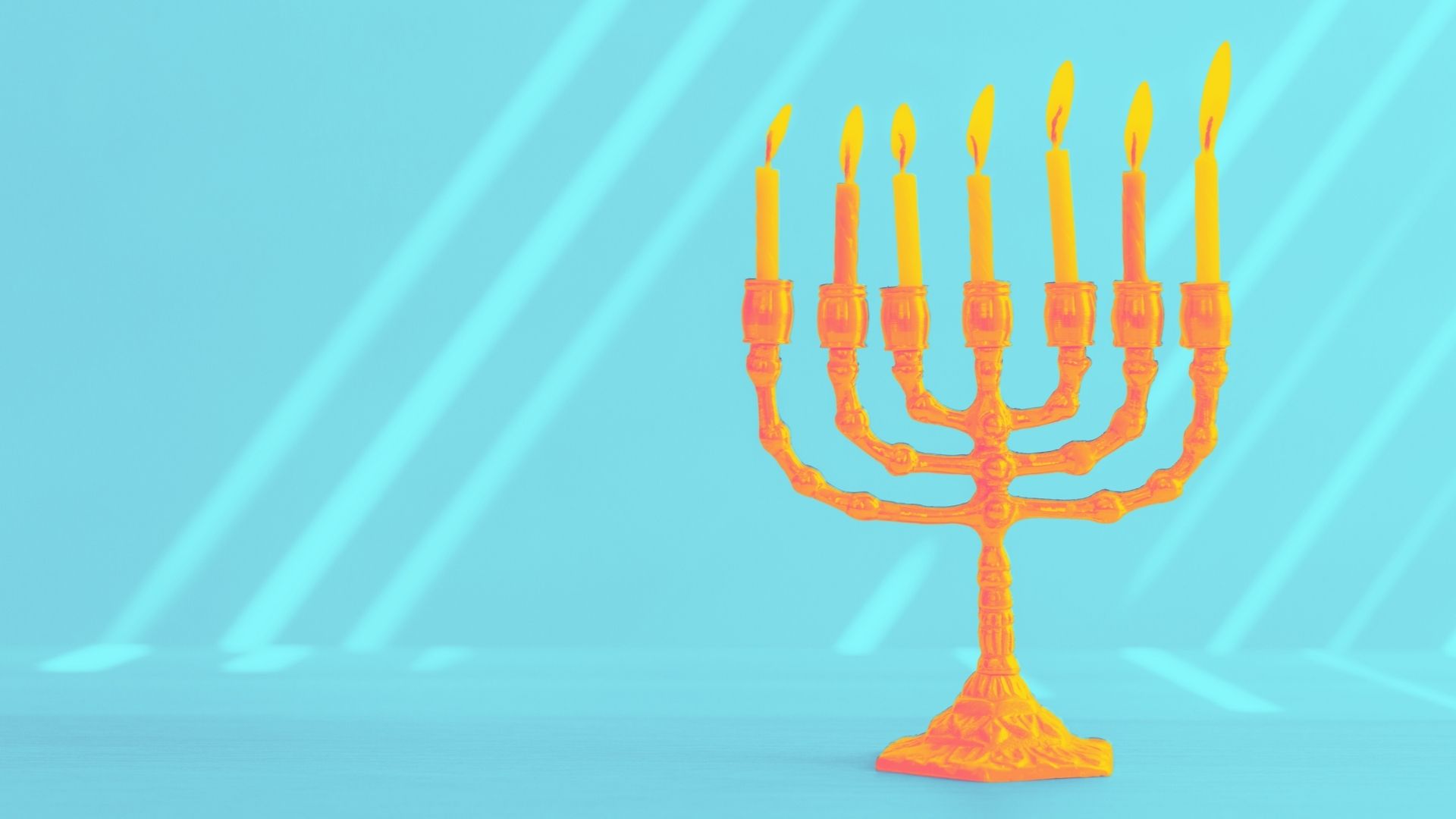
Though this account was first recorded later in the Talmud rather than in the earliest sources, it captures the imagination. Out of this grew the central custom of the holiday: lighting the hanukkiah, a nine-branched candelabrum representing this miracle of God’s provision. On each of the eight nights, another candle is kindled using the central shamash (servant) candle, until by the final night all eight flames, representing the eight days the oil burned, shine brightly.
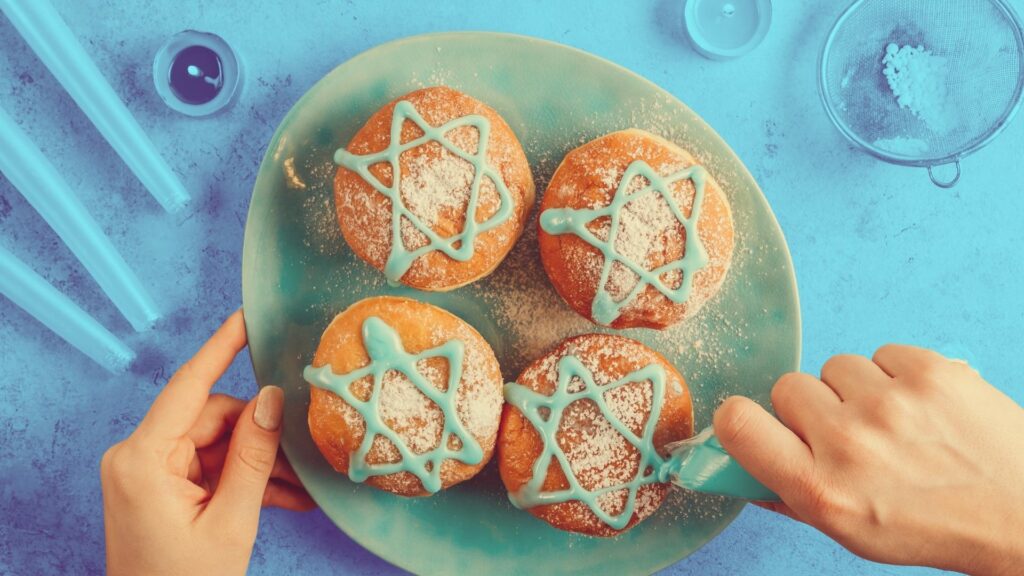
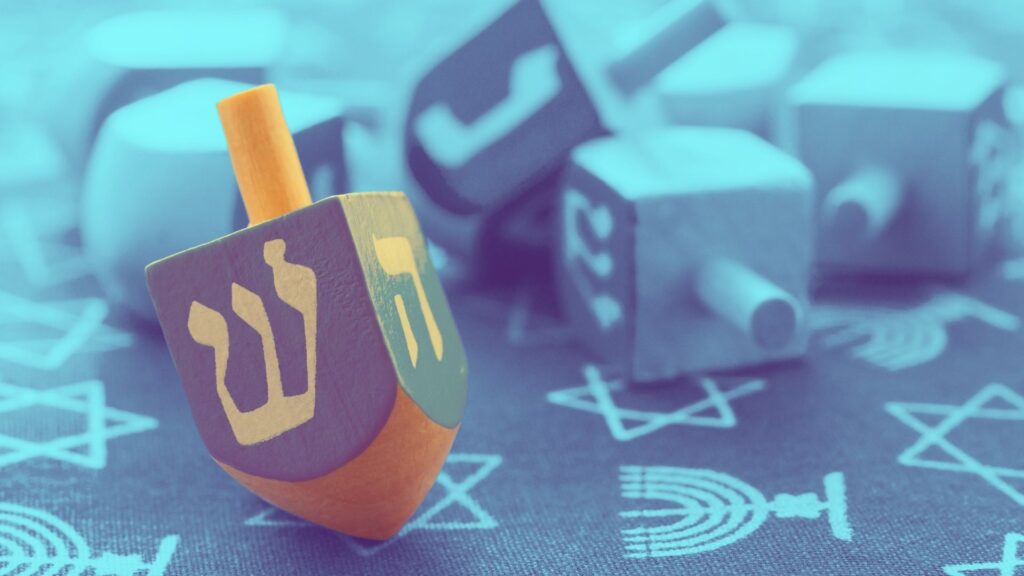
Other customs have since followed. Children spin the dreidel, a top marked with Hebrew letters that stand for the phrase ‘A great miracle happened there.’ Families enjoy fried foods such as potato pancakes (latkes) and jelly-filled donuts (sufganiyot), symbolising the miracle of the oil. And in Jewish homes around the world, hymns such as Maoz Tzur (‘Rock of Ages’) are sung, recounting God’s deliverance throughout the ages.
These traditions are not commanded in Hebrew Scripture, yet they point back to the miracle of God’s preservation and provision of light. They also help explain why Hanukkah became such a meaningful backdrop for the ministry of Jesus.
Jesus at Hanukkah
When we speak of Hanukkah, we often focus on the miracle of the oil. However, the miracle of preservation that the oil represents is perhaps even more important to commemorate. Against impossible odds, God preserved his people. Had Antiochus succeeded in erasing Jewish faith, Israel’s identity might have vanished. And without the Jewish people, there would be no Messiah.
without Hanukkah, there would be no Christmas.
The miracle of Hanukkah is that God kept his promise, ensuring that the line of David would remain and that the Messiah would come as foretold. That’s why we often say at Jews for Jesus that without Hanukkah, there would be no Christmas.
Many years later, John’s gospel records that Jesus was in the Temple at Hanukkah, walking in Solomon’s Colonnade. This was no casual detail: it shows that Jesus was aligning himself with the themes the Temple embodied. John is not just giving historical colour; he is signalling that Jesus’ identity and mission are intimately connected to God’s faithfulness and the spiritual light symbolised by Hanukkah. And Jesus’ message wasn’t just pointing to God’s provision and deliverance; he was revealing that he himself is their fulfillment.
The Jewish people, remembering God’s deliverance from Antiochus, pressed him with a question: ‘How long will you keep us in suspense? If you are the Christ, tell us plainly’ (John 10:24). They longed for another Maccabee, a warrior who would free them from Rome. But Jesus offered something greater.
‘My sheep hear my voice, and I know them, and they follow me. I give them eternal life, and they will never perish, and no one will snatch them out of my hand. My Father, who has given them to me, is greater than all, and no one is able to snatch them out of the Father’s hand. I and the Father are one’ (John 10:27–30).
This was staggering. The Jewish leaders had rightly rejected Antiochus’ blasphemous claim to be ‘god manifest’. Now they accused Jesus of blasphemy for declaring oneness with the Father and picked up stones to kill him (John 10:31).
Jesus truly is Immanuel, God with us, who came to preserve his people not only on earth but for eternity.
Unlike Antiochus, Jesus truly is Immanuel, God with us. He is greater than the Temple itself (Matt 12:6). He came not only to preserve his people on earth but for eternity.
Celebrating Hanukkah as Followers of Jesus
While celebrating Hanukkah is not commanded by God in the Hebrew Scriptures, if Jesus celebrated Hanukkah, shouldn’t his followers at least consider it?
As the sun sets this year on the evening of December 14, flowing through the evening of the 22nd, I want to invite you to see Hanukkah not only as Jewish history but as part of your own faith story as you worship the Messiah who took this holiday to proclaim himself one with God, not only in word but in the fulfillment of himself.
Lighting a hanukkiah (Hanukkah menorah) at home can become a family devotion, each flame reminding us of Jesus, the Light of the World. Reading passages from John 10 or Isaiah 9 alongside the candlelight deepens the connection. Families can also pray for Jewish friends and neighbours, asking that the same Light of life might shine into their hearts.
It can also be meaningful to join in the joy of tradition. Sharing latkes or sufganiyot with Jewish neighbours, or even learning the simple dreidel game, opens natural doors for friendship. Small gestures of kindness or thoughtful gifts communicate genuine respect and love.
And when opportunities arise for conversation, Hanukkah itself points to Jesus. You might gently mention that Jesus celebrated Hanukkah, as recorded in John’s Gospel. Or note how God preserved his people so that the Messiah could come, and ask if a friend has experienced God’s preserving hand in their own life. Or reflect on the shamash candle, the servant that lights the others, and how it reminds us of Jesus. These are not debates to win but conversations that can plant seeds of curiosity.
The Greater Miracle
At its heart, Hanukkah commemorates God’s power to preserve his people, while Christmas celebrates God’s presence with his people. Both find their fulfillment in Jesus, the Light of the World, the faithful Shepherd, Immanuel.
This holiday season, as Jewish families kindle their hanukkiah and Christians light their Advent candles, may we see the shared hope shining in both. God keeps his promises. He has come to us in Jesus, and in him we have eternal life. ‘Arise, shine, for your light has come, and the glory of the LORD has risen upon you’ (Isa 60:1).
Our faith is rooted in God’s covenant with Israel; the story of Jesus is inextricably linked to the story of the Jewish people. Hanukkah calls us to be bearers of light in our own day. Just as the Maccabees refused to compromise their faith in the face of darkness, and just as Jesus declared himself the Light of the World during Hanukkah, so we are called to let his light shine through us.
This season, may we lead our churches and communities not only to celebrate Christmas but also to enter into the joy of Hanukkah, the Feast of Dedication. For in celebrating both, we proclaim one great truth: that the God who preserved His people Israel has come to be with us in Jesus the Messiah, and His light shines to the ends of the earth.