

Initiatives and Challenges in the Diaspora
Diaspora describes the global movement of people, whether by choice or necessity, shaped by conflicts, crises, persecution, or environmental disasters. This movement extends beyond first-generation immigrants to their descendants, whose identities are influenced by inherited memories and experiences. Within evangelical Christianity, the Lausanne Movement analyzes diaspora through a biblical-missiological lens, highlighting human mobility as a key element of God’s mission.
Diaspora extends beyond first-generation immigrants to their descendants, whose identities are influenced by inherited memories and experiences.
Since the first Lausanne Congress in 1974, the concept of taking ‘the whole Gospel to all people’ has included reflection on people on the move. However, only in 2004, at the Lausanne Movement forum in Pattaya, Thailand1 that this theme became a specific network. The consultation’s reflections were compiled in “The New People Next Door – LOP 55″.2 At the Third Lausanne Congress in Cape Town, the diaspora became a central focus, leading to collaborative actions, including the official launch of the Global Diaspora Network (GDN).
Recently, the GDN has worked with determination and strategic vision to develop diasporic missiology. It promotes academic dialogue among people from different regions. This work has produced reflections, documents, and consultations that deepen the theological understanding of the diaspora. Currently, three publications are available in Portuguese: the e-book ‘Dispersed for the Harvest: Embracing the Global Trend of the Diaspora’3—a summary of the compendium “Scattered and Gathered”4—and the Lausanne Occasional Papers ‘People on the Move – LOP 70,”5 and ‘People in Forced Displacement – LOP 77″.6

Diasporas inside and outside Latin America and the Caribbean
The limited availability of resources in Portuguese and Spanish underscores an urgent need for stronger Latin American participation in global diaspora conversations. Addressing this gap was a driving force behind the Global Diaspora Network’s decision to convene a dedicated consultation in Latin America, ensuring regional voices contribute to global strategies.
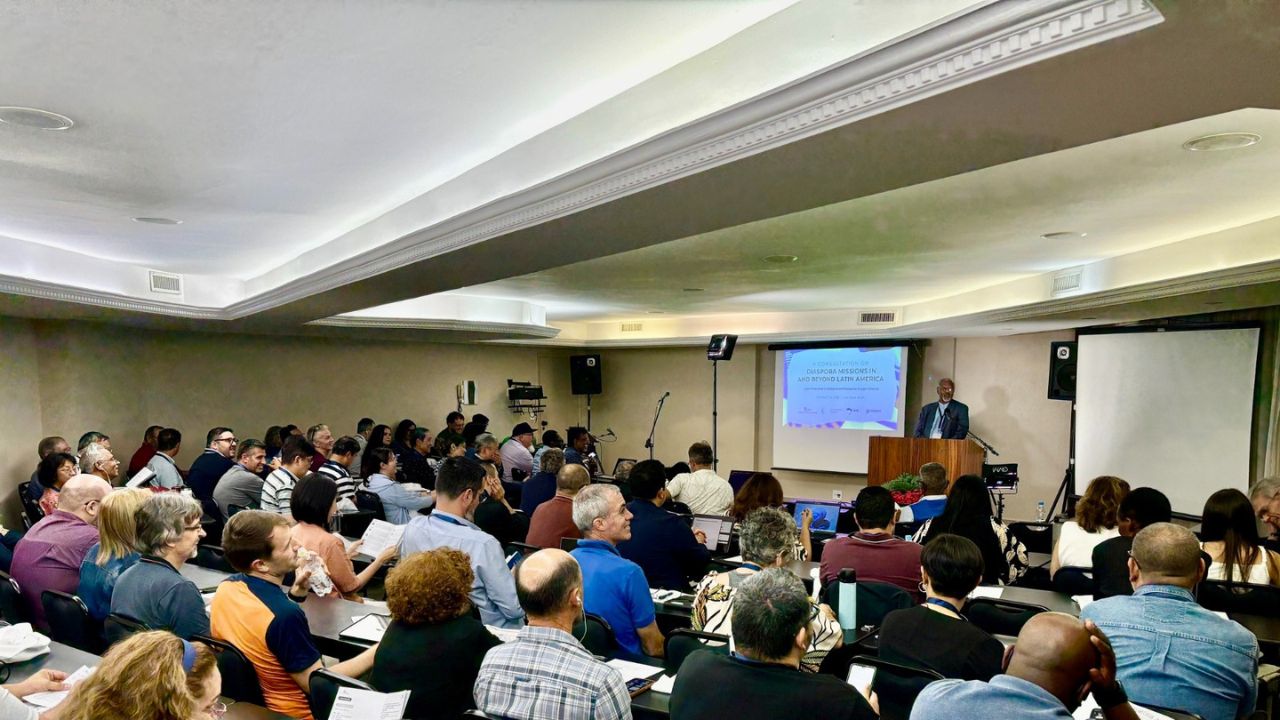
The event, called “Diasporas Inside and Outside Latin America and the Caribbean,” took place from October 2 to 5, 2025, in São Paulo. It gathered 120 representatives from 38 countries and various ethnic groups. The audience was diverse, with men and women, young and older participants, and professionals from multiple fields. Academics and missiologists, missionaries, pastors, and leaders each contributed essential insights. Key takeaways included new collaborations across disciplines, expanded awareness of diaspora challenges, and strengthened theological and missiological dialogue on diasporas in the Latin American and Caribbean region.
The audience was diverse, with men and women, young and older participants, and professionals from multiple fields. Each contributed essential insights.
The consultation was officially held in three languages: Portuguese, English, and Spanish. Experts presented their research in their native languages. A key highlight was the diasporic reading of the Book of Ruth, which addressed historical, social, and theological questions about its impact on global Christianity. Contributors such as Elias Dantas, Analzira Nascimento, Débora Fahur, Marcos Grava, Johnny Ramirez-Johnson, Bulus Galadima, and Loida Carriel Espinoza shared insights on partnerships and practices relevant to the region and the global context.
This meeting was not a one-time event. Instead, it marks the beginning of ongoing collaboration, starting with the launch of the book Diasporas Inside and Outside Latin America, soon to be published by Langham Publishing. The key takeaway is that this work seeks to increase the subject’s visibility and foster both theological and practical discussion within the region.
Latin America’s Potential for the Diaspora
In Scripture, the movement of peoples is seen not just as a result of crises but as part of God’s action in history. Human mobility is more than a sociological issue; it is an instrument and an opportunity for divine mission. Sam George, former catalyst of the Diaspora Network, notes that diaspora plays a strategic role in global evangelization. The current migration context gives churches in Brazil, Latin America, and the Caribbean a unique chance to join the global mission.
In Scripture, the movement of peoples is seen not just as a result of crises but as part of God’s action in history.
In the Latin American context, people on the move must be welcomed. Their needs include not only spiritual demands, but also legal status, migration regularization, social vulnerabilities, and complex issues such as crimes, forced migrations, and racism. When these people receive contextualized evangelization and intentional discipleship—including pastoral care, theological training, and missionary empowerment—they can reach others, even those still inaccessible to the local church. More than five million Brazilians and millions of other Latin Americans abroad represent both a pastoral challenge and a potential missionary force.
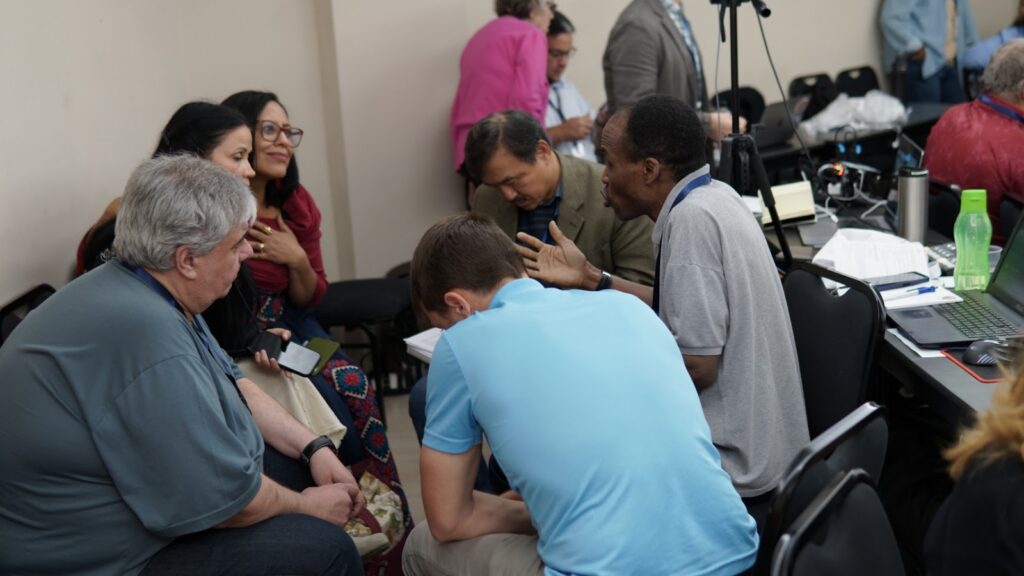
This collective effort aims to advance practical, transformative responses to the realities of diasporas in Latin America and the Caribbean. Its goal is to renew theological perspectives and missionary practices to meet contemporary migration challenges. As highlighted by Z. Lima and Ukrainian Lyuda in the consultation, healthy diaspora missiology must build intercultural tables grounded in hospitality, attentive listening, and genuine welcome, intentionally creating spaces for encounter, reconciliation, and peacebuilding.
Endnote
- See: https://lausanne.org/gathering/2004-forum
- See: https://lausanne.org/wp-content/uploads/2007/06/LOP55_IG26.pdf
- Global Diaspora Network; Medeiros, Elias; Paek, Greg Woon Young. Dispersos para a Colheita: Abraçando a Tendência Global da Diáspora – Edição Revisada [e-book]. 2020. https://www.amazon.com.br/DISPERSOS-PARA-COLHEITA-Abra%C3%A7ando-Tend%C3%AAncia-ebook/dp/B08GF61HV6/
- Tira, Sadiri Joy; Yamamori, Tetsunao (eds.). Scattered and gathered: a global compendium of diaspora missiology. Carlisle: Langham Global Library, 2020.
- See https://lausanne.org/pt-br/occasional-paper/pessoas-em-movimento
- See https://lausanne.org/pt-br/occasional-paper/pessoas-em-deslocamento-forcado