



























Introduction
Loneliness and social isolation are widespread in today’s world. They affect one in six people globally and form a serious global public health issue.1 Loneliness has become common across all age groups and geographical regions. It can cause serious physical and mental health problems, negatively impact a person’s wellbeing, and it can even lead to death.2 People need social connections in order to flourish and be healthy in every aspect of their lives.
Loneliness is a common and shared experience for people who have been marginalized. They are considered of lesser importance by others, have been excluded and pushed to the margins of society. Therefore, marginalized groups— people with disabilities, people with HIV/AIDS, refugees and immigrants, for example,—do not belong.
In the context of mission, loneliness among marginalized groups seems to be a blind spot. In this article, we will explore how loneliness can be a barrier to missional outreach, but also an opportunity for mission. We will also look at the importance of belonging for discipleship. And we will finish with some thoughts on marginalized people as gospel agents.

Loneliness as a Barrier to Missions
First of all, loneliness can form a barrier for mission because marginalized people tend to be hidden from our view. They may not be tolerated in public spaces and may dwell in places where others will not go. For example, a child with a disability is in some cultures considered a shame for the family. Having a child with a disability is seen as caused by wrongdoing in the parents’ lives. Therefore, the parents experience stigma, discrimination and shame. As a result, they may hide their son or daughter in the backroom of their home. Not to be seen. And utterly lonely.
The Bible calls us to go out and bring in people who are considered of lesser value by others (Luke 14:21). But how can we go out and bring into the kingdom those groups that are hidden from our sight? One way to overcome this barrier is by learning about marginalized groups in our local context. Which people have been pushed to the margins and experience loneliness in the community where I live or minister? And where could we most likely find these people?
Loneliness as an Opening for Gospel Witness
Loneliness is not only a barrier in our mission efforts; it also offers opportunities for gospel witness. If you have been rejected by others in your community and are experiencing loneliness, what would be better news than the gospel? Loneliness is a deeply negative experience, but as Christians we have a message of hope. God himself wants to minister to the lonely in their loneliness. And as his children, we can offer gospel presence and friendship; exactly the things that marginalized people long for.
We could see such outreach as a pre-evangelistic approach in missions. However, we should not just meet with people in their loneliness as a means to an end, namely reaching them for Christ. Personally, I’d rather see such outreach as a form of integral mission. A holistic missional approach that ministers not only to the social or emotional needs of the people we encounter but sees them as ‘whole persons,’ who need Christ and who seek belonging. This approach may especially be suitable for countries where open gospel proclamation is not permitted.
Belonging as a Necessity for Discipleship
The church can provide belonging and can be a place where lonely, marginalized people can build meaningful relationships with others and be part of the body of Christ. In fact, this is exactly one of the five core values of thriving missional communities.3 But what do we mean by belonging? A disability theology model of belonging may be of help. Although its focus is on people with disabilities, it also applies to ministering to other marginalized and lonely groups that we may encounter in our missional context, such as refugees, immigrants, people affected by HIV/AIDS, among others.
One model of belonging identifies ten dimensions of belonging: being present, invited, welcomed, known, accepted, supported, cared for, befriended, needed, and loved (see figure 1).4 The model also provides five steps to encourage belonging: choosing to invite marginalized persons, investing time in them, yielding into and committing to the relationship, and seeing them flourish.
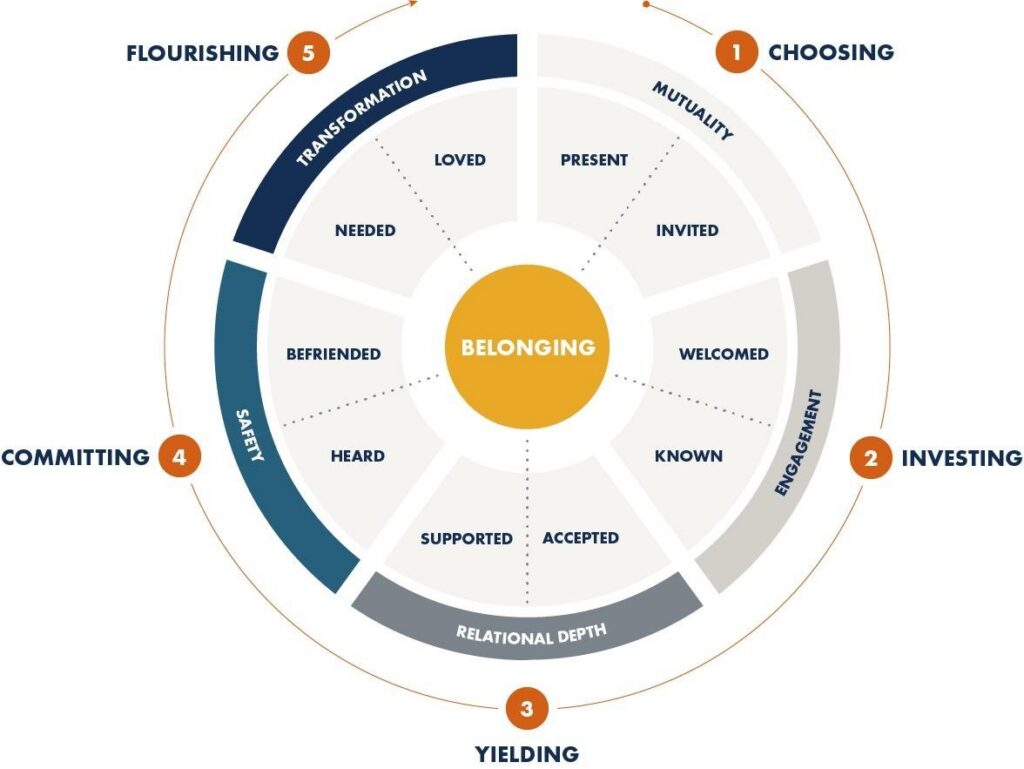
Figure 1. The ten dimensions of belonging and five steps to building relationships.
These five steps are not only needed to develop a sense of belonging; they are also a necessity for discipleship. They can even accelerate the process of discipling others. If we are intentional about building relationships with people, investing time in them, and providing them with opportunities to flourish, they will grow as followers of Christ.
The gospel offers an eternal solution for the problem of loneliness, as it connects us with the Lord of life, and places us within the body of Christ, connected with fellow believers.
Of course, we need to keep in mind that true belonging can only be found in/through Christ. It goes beyond connecting with others at a social level. In the end, only when marginalized people (or anyone for that matter!) come to know Christ, will they have a chance to find true belonging. The gospel offers an eternal solution for the problem of loneliness, as it connects us with the Lord of life, and places us within the body of Christ, connected with fellow believers.

Marginalized People as Gospel Agents
Finally, marginalized people not only need to be reached with the gospel. Once they enter God’s kingdom, they also receive the call to go out and make disciples—just like all of us. They are not just recipients of ministry and mission; they are fellow gospel agents. And because of their lived experience of being rejected and lonely, they can make an essential contribution to the missional task of the global church.
If, as mission leaders, we cannot facilitate the missional call of persons who experienced marginalization, then we will only push them into new experiences of loneliness. We need to take this very seriously. If we cannot see them as fellow gospel workers, they will again experience the loneliness of exclusion. Church and mission leaders may find it challenging, though. We may need to educate ourselves on how to enable marginalized people to take their rightful place as gospel agents.
If, as mission leaders, we cannot facilitate the missional call of persons who experienced marginalization, then we will only push them into new experiences of loneliness.
Conclusion
People who have been marginalized by others in their community, share the lived experience of loneliness. That loneliness can easily pose a barrier in missional endeavours, as the ones we seek to reach may literally be hidden in backrooms. However, loneliness can also provide new opportunities for mission. Meeting marginalized people in their loneliness means meeting a deep need for social connection. As the church, we can offer gospel presence and a place of belonging, while the Lord himself can minister to their deepest needs. And finally, even though at times it may feel uncomfortable, we need to provide space and missional opportunities to people who have experienced marginalization and loneliness. They have much to offer.
Endnotes
- Societies (Geneva: World Health Organisation, 2025)
- WHO Commission on Social Connection, From Loneliness to Social Connection: Charting a Path to Healthier Societies (Geneva: World Health Organisation, 2025)
- See: Church Reimagined: Mission That Forms Thriving Communities.
- Erik Carter, “A Place of Belonging: Including Individuals with Significant Disabilities in Faith Communities,” Inclusive Practices 1, no. 1, 6–12, https://doi.org/10.1177/2732474520977482. To access the PDF, see https://disability.research.baylor.edu/sites/g/files/ecbvkj1796/files/2024-11/a_place_of_belonging.pdf. For the five steps, see https://www.wheaton.edu/wheaton-center-for-faith-and-disability/disability-foundations/dimensions-of-belonging