


























Editor's Note
This new series explores the holidays of world religions to help us understand and engage meaningfully and missionally with our neighbours of other beliefs in practical ways. In this series, we uncover what we can learn from these festivals that can enrich our biblical understanding, discipleship and mission. Each article invites the church to deepen faith, reach out to religious communities with humility and love, and participate in God’s reconciling mission to the world.
Introduction
In the West, Muslims are on the increase partly through migration and partly through a high birth rate. Jesus commissioned his church to go to all nations and teach them what he taught.
One of the most commonly asked questions I face in my ministry is:
‘How do we witness to Muslims?’
Understanding Islam and presenting a comparative picture to our Muslim neighbours, in my opinion, is the most effective way of sharing the gospel of Jesus Christ with our Muslim neighbours. Ramadan offers a unique opportunity to the church in this context.

What is Ramadan?
Every year, we hear Muslim neighbours wishing one another Ramadan Mubarak (a blessed Ramadan), which is a major Eid (festival) in the Muslim calendar.
It falls on the ninth month of the Islamic lunar year, during which Muslims, with certain exemptions, are expected to fast from dawn to sunset, which involves abstaining from food and drink, smoking, and sexual intercourse. Fasting is one of the five tenets of Islam.1 The fast is broken after sunset, at which time they have the meal called iftar, which literally means breaking. They also have an early breakfast called suhoor, before dawn.
For Muslims, Ramadan is a month of devotion to Allah, during which they seek to please him by self-discipline, repentance, prayer, and generosity.
For Muslims, Ramadan is a month of devotion to Allah, during which they seek to please him by self-discipline, repentance, prayer, and generosity. It is a month of taqwah (consciousness of Allah). Some increase their daily prayers above and beyond the mandatory five prayers a day. They also have taraweeh, additional prayers at the mosque. Some Muslims pray especially during the last ten nights of Ramadan, seeking Laylat al-Qadar (the night of destiny)2 during which it is believed Muhammad was given the Qur’an by Jibril. Further, they read the Qur’an more extensively, some reading it in its entirety during Ramadan. Finally, they increase their charitable giving, especially at the end of Ramadan, with the intention of supporting those in need, to enable them to enjoy the final celebration of Ramadan.
The Feast Presents an Evangelistic Opportunity
The origin of Muslim Ramadan is said to be associated with tanzil—Allah sending the Qur’an down to Muhammad—although pre-Islamic Arabs celebrated Ramadan too, in a somewhat different way. As such, Ramadan is one of the best opportunities for a respectful gospel-shaped interaction, not least because during Ramadan, many Muslims are actually in a spiritually seeking mood. Christians should seize this opportunity with love for their neighbours, seeking to share the gospel of salvation, God’s free and saving grace, leading to eternal life through the sacrifice of Jesus.
Ramadan is one of the best opportunities for a respectful gospel-shaped interaction
Means of Muslim Conversion to Christ
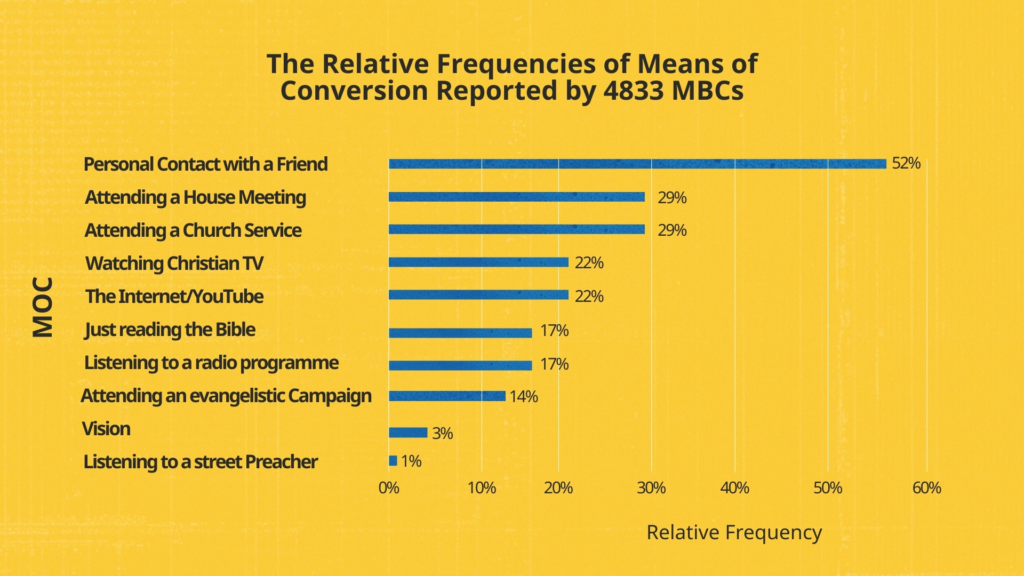
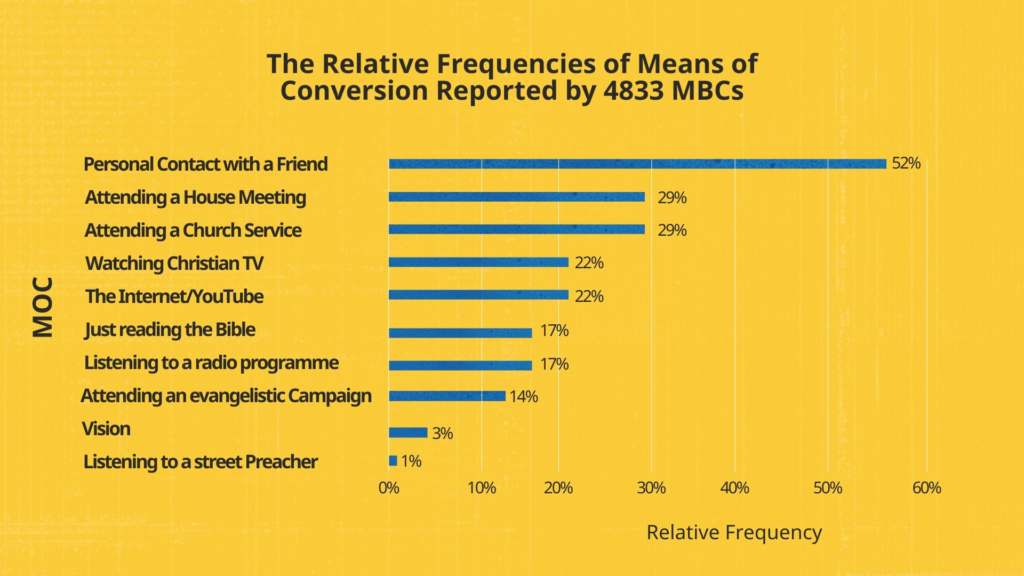
My research which draws on responses from 4,833 Muslim Background Christians (MBCs) indicates that the majority came to faith through personal interaction with Christians. As illustrated in the accompanying graphic showing the relative frequencies of reported Means of Conversion (MOC), relational engagement plays a central role in journeys to Christ. Within this context, Ramadan represents a significant opportunity for meaningful interaction with Muslims and for initiating conversations about Jesus.
What can Christians do during Ramadan in order to familiarise their Muslim neighbour with Christ? What follows is essentially a means of bridge-building, without compromising our Christian faith:
Respect a Muslim Neighbour’s Feelings
Avoid eating or drinking ostentatiously in the presence of Muslim neighbours or colleagues during Ramadan. I often tell my colleagues that I would eat in a private space to avoid offending them.
Further, you can always affirm their desire to please God and explain why Christians are not expected to make a literal sacrifice of a sheep or fast ritualistically. Share how you feel about pleasing God, the Most Holy One. Can we ever really please him fully? Share the concept of sacrifice. They do it to feed the poor. Jesus did it once and for all to pay for our sins.
Show Interest and Care
Many Muslims, more so devout Muslims who follow Ramadan traditions to the letter, especially in hot climates, suffer. Just show sympathy and ask, ‘How are you coping?’ or ‘How is your Ramadan going?’
Accept Invitations to Iftar
This does not happen very often and should be considered a sign of favour by the Muslim host. Accept graciously.
Offer Iftar
Many Christians in the Middle East offer food in the streets to their Muslim neighbours. This can be given on a tray or in a bag. These bags may contain a message of goodwill, and a copy of a gospel, or a film about the life of Jesus. Some invite their Muslim neighbours to their homes. Some churches use their church halls to offer Iftar.
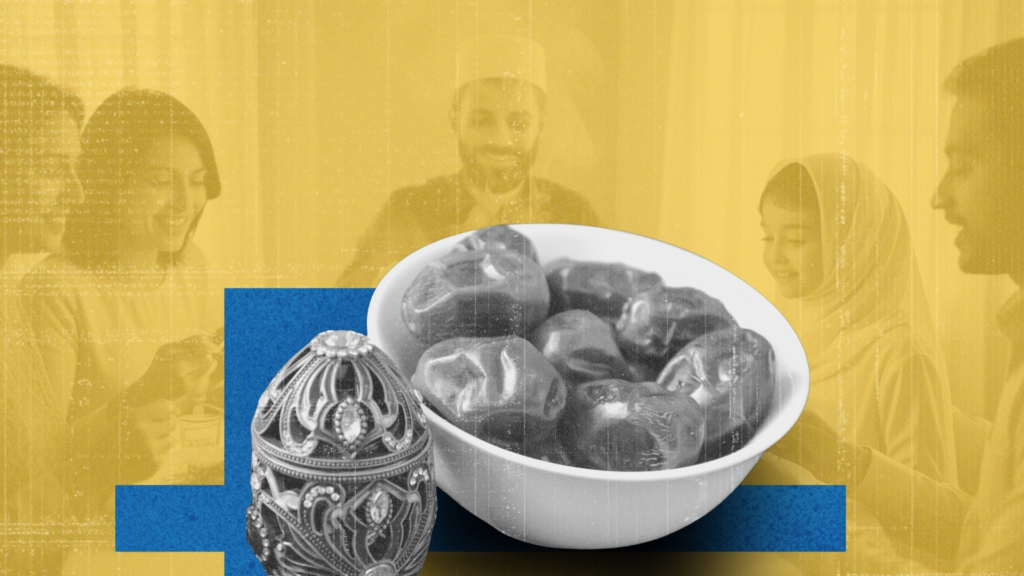
Egyptian Christians providing Iftar for their Muslim Neighbours.
Fast with your neighbour — but in the Christian Way
For instance, you could avoid breakfast altogether. Explain that Jesus said, ‘That kind of spirit comes out only if you use prayer and fasting.’ (Matt 17:21). In fact, many Muslims go to church to be freed from demon possession because they have learnt that Christian prayer has the power to heal and redeem.
Give Gifts
You could also consider giving a meaningful, thoughtful gift with a card carrying a Christian message.

Engage in Conversation/ Ask Questions
The Bible tells us that many of Christ’s evangelistic efforts began with a question. Jesus is recorded as having asked over 300 questions across the four gospels. So why not ask your Muslim neighbour what Ramadan means for them?
You could start with, ‘As a non-Muslim, I am curious to know what you gain by fasting during Ramadan,’ and after their response, you could offer something like, ‘I admire your desire and search for God’s forgiveness. Can I share how I think about forgiveness as a Christian?’
If your conversation partner is open to sharing, you can take it to a much deeper level and ask personal questions like, ‘Do you feel God’s forgiveness during Ramadan?’ This, in turn, may raise the question of how Christians know they are forgiven.
To show some awareness and interest, you can ask how difficult it is to keep the five pillars of Islam, especially those associated with Ramadan: prayer, fasting, and almsgiving. Share why Christians are not obliged to fast.
Be encouraged by findings from the same research study of 4,833 MBCs. As shown in the accompanying graphic on the relative frequencies of Repelling Conversion Factors (RCFs), 17% of respondents reported that they were repelled from Islam because it is a religion based on the concept of salvation by works.
Explain Why Christians Do Not Have the Equivalent of Ramadan
Muslims ask many questions. Peter instructed us to:
‘But in your hearts revere Christ as Lord. Always be prepared to give an answer to everyone who asks you to give the reason for the hope that you have. But do this with gentleness and respect’ (1 Peter 3:15, NIV).
Share About the Life of Jesus
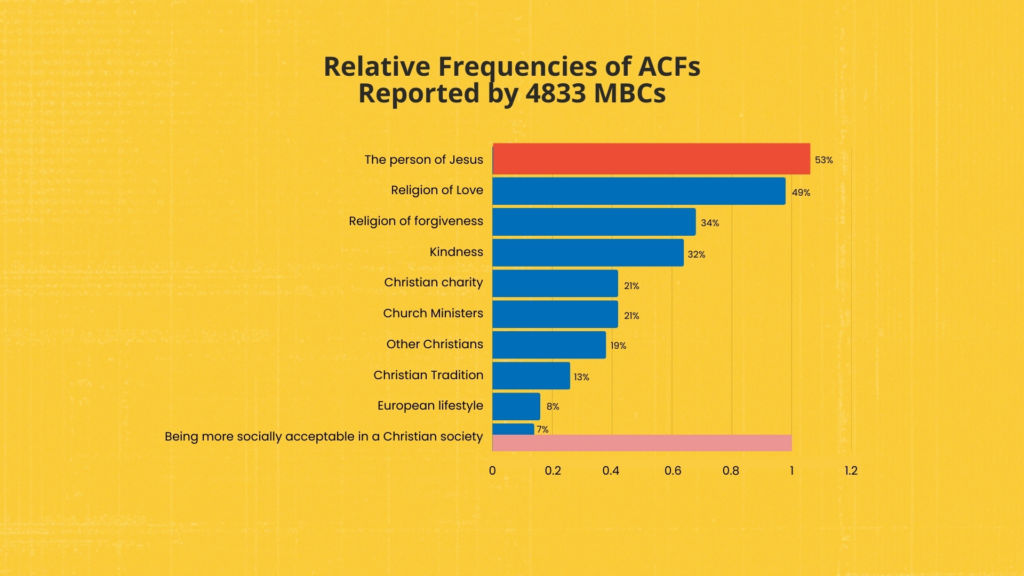
Furthermore, findings from the same research study highlight that for Muslims, the most attractive aspect of Christianity is the person of Jesus. As illustrated in the accompanying graphic showing the relative frequencies of Attractive Conversion Factors (ACFs), Jesus stands out as the primary draw in their journey toward faith.
for Muslims, the most attractive aspect of Christianity is the person of Jesus.
Themes to discuss with Muslim neighbours
I have listed some verses below, which illustrate the life of Jesus. The list is by no means exhaustive. You can always use your own choice of Scripture.
| Matthew 4:1-17 | Jesus fasted for 40 days. Jesus is tested in the wilderness. ‘Worship the Lord your God, and serve him only.’ |
| Romans 5:1 | ‘Therefore, since we have been justified through faith, we have peace with God through our Lord Jesus Christ,’ |
| John 6:35 | ‘Jesus said, “I am the bread of life.” |
| 1 John 5:11–13 | How Christians have assurance of their salvation. Grace/faith. |
| Luke 12:33 | Jesus’ equivalent of Zakat. ‘Sell your possessions and give to the poor. Provide purses for yourselves that will not wear out, a treasure in heaven that will never fail, where no thief comes near and no moth destroys.’ |
| Ephesians 2:8-9 | ‘For it is by grace you have been saved, through faith—and this is not from yourselves, it is the gift of God—not by works, so that no one can boast.’ |
| Luke 23:43 | ‘Jesus answered him [a thief], “Truly I tell you, today you will be with me in paradise.” |
| John 1:1-4 | Jesus the Word (mentioned in the Qur’an) |
| John 3:16 | How can we be sure of God’s love? |
Share a Testimony of a Convert from Islam
Amongst Paul’s 15 evangelistic styles reflected in the Book of Acts, we find the testimonial style (Acts 22:1–21 and Acts 26:1–23), which draws on the fact that the human brain is constructed with a strong affinity for narrative or stories.
Use the questioning style to share the testimony of a convert from Islam to Christianity (Thabiti Anyabwile)3. ‘I wonder what you think of this ex-Muslim, who left Islam because of Ramadan? Do you think he misunderstood Ramadan?’
Summary
The message is: Understand Ramadan and what it means to Muslims. Use it as a bridge builder and an opportunity to share the love of God with these sincere seekers after God. Be considerate, kind, respectful, and sensitive. But above all, share the story of the Lord Jesus and how he came to fulfil the law, and remove the burden of rituals and feasts. Offer a contrast between what a Muslim has and what you have to look forward to in the life to come.
Endnotes
- Shahadah, the Declaration of Faith, 2) Salah, Daily Prayer, 3) Zakat, Almsgiving, 4) Sawm, Fasting, and 5) Hajj, Pilgrimage to Mecca.
- Qur’an 97; Qur’an 2:185 and Qur’an 44:33
- Gospel Confidence in Evangelizing Muslims: An Interview with Thabiti Anyabwile