



























Current Landscape and Direction
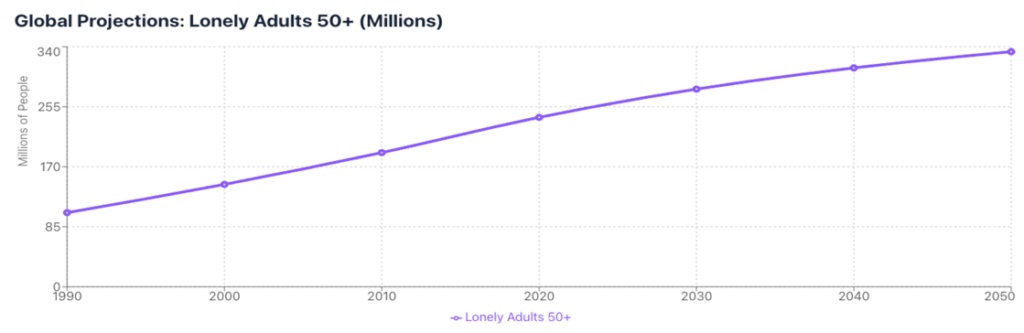
Loneliness among older adults has emerged as one of the most urgent global missional challenges of the twenty-first century. Current estimates suggest that 27–35% of adults aged 65+—approximately 235 million people worldwide—experience persistent loneliness. With global ageing accelerating, the population over 65 is projected to exceed 1.5 billion by 2050, meaning the absolute burden of loneliness is likely to double or triple in coming decades, particularly in Asia, Europe, and the Americas.1
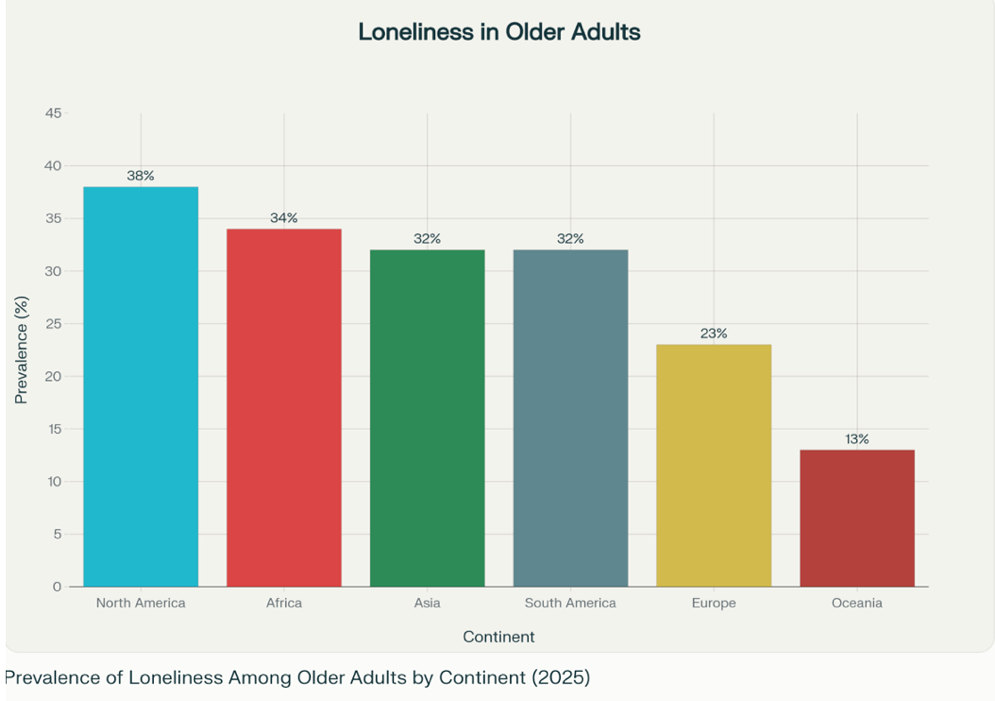
The projection, following long term trends, is as follows; the absolute burden of loneliness will grow significantly.2
Loneliness is not a benign emotional state; among older adults loneliness associates robustly with increased depression (2x the norm),3 anxiety (1.5x the norm),4 cardiovascular disease,5 higher risk of dementia6 and suicidal ideation,7 functional decline,8 elevated mortality equivalent to smoking 15 cigarettes daily 9 and increases the risk of stroke by 32%.10
Risk factors are well established: female gender, widowhood or singleness, living alone, poor physical or mental health, low income, institutionalization, cognitive impairment, and rural isolation. Yet these individual factors are nested within deeper structural forces reshaping late-life experience across cultures.
Structural Drivers of Loneliness
Four intersecting structural crises—together with a fifth, deeper spiritual dimension—drive the current epidemic.
Cultural Fragmentation
The intergenerational living and caregiving roles that once gave older adults purpose and recognition have been dismantled by cultural fragmentation. In North America and Europe, hyper-individualism and geographic mobility disperse families; in Africa and Asia, rural-to-urban migration erodes village-based social life. In both cases, elders lose daily relational significance.
Technological Change
Technological change intensifies cultural fragmentation in ambivalent ways. Digital exclusion marginalizes many older adults through limited access, low digital literacy, or rapid platform change. Conversely, where technology is ubiquitous, mediated relationships often replace embodied presence. Emerging AI companions raise unresolved questions: they may reduce distress for some, yet risk deepening digital loneliness by simulating recognition without mutuality.
Political and civic erosion
This further weakens belonging. Polarization channels lonely individuals into ideological tribes while eliminating bridging relationships. The disappearance of everyday’ third spaces’ outside home and work removes low-threshold encounters that sustain dignity—sometimes leaving a brief exchange with a cashier as the day’s only human contact.
Theological and ecclesial decline
Reduced religious participation removes a historic buffer against isolation, while deficient ecclesiology reframes church as a service provider rather than a community of mutual presence. Age-segregation, pastoral burnout, and shrinking congregations leave many older adults quietly disengaging.
The Spiritual Dimension
At its core, loneliness is not only social but existential. Across cultures, older adulthood carries an expectation of generativity: to contribute, mentor, and bless others. When opportunities for meaningful contribution disappear, loneliness becomes a crisis of recognition, agency, and purpose. The loss of religious community intensifies this wound by removing spaces of transcendence, shared meaning, and sacred belonging—where one is seen not for productivity but for presence.

Missional Challenges and Opportunities
Loneliness is not peripheral to the church’s mission; it directly undermines evangelism, discipleship, and leadership formation. With over one-third of older adults globally reporting persistent isolation, the church must face an uncomfortable truth: it has often mirrored the very fragmentation it exists to heal. When efficiency eclipses presence and programs replace proximity, the body of Christ becomes structurally incoherent.
Evangelism falters when isolated elders distrust institutions and lack relational pathways into faith. Yet isolation also generates profound spiritual hunger. Authentic evangelism therefore may begin more with presence—visitation, meals, listening—where hospitality itself becomes gospel witness (Psalm 68:6) than with proclamation.
Loneliness severs intergenerational wisdom-sharing (Titus 2:2–5), depriving younger believers of narrative depth and older believers of vocation.
Discipleship withers when reduced to information transfer. Loneliness severs intergenerational wisdom-sharing (Titus 2:2–5), depriving younger believers of narrative depth and older believers of vocation. Leadership formation likewise erodes: nearly half of clergy report significant loneliness, hollowing out ministry from within. The church cannot form incarnational leaders without communities capable of shared vulnerability fostered by authentic hospitality, itself fostered by the older generations.
Foresight Future Scenarios: Four Plausible Futures (2030–2040)
Scenario A: Solitary Networks
Loneliness deepens amid persuasive AI companions and curated digital belonging. Spiritual formation becomes transactional, embodied pastoral care erodes, and the digitally excluded are further marginalized.
Scenario B: Embodied Revival
Cultural hunger for real connection returns. Churches become renewed centers of intergenerational life and local solidarity, restoring the ‘third spaces’ society has lost.
Scenario C: Digital Asceticism
In reaction, some churches reject technology entirely, becoming intense households of refuge. While spiritually rich, they risk insularity and social withdrawal.
Scenario D: Integrated Hope
Technology is ethically integrated to support rather than replace embodied community. Hybrid models expand access, enhance care, and strengthen relational depth.

Implications for the Great Commission
Loneliness reveals a mission field not of ignorance but of invisibility. Evangelism without community formation is incomplete; discipleship cannot occur apart from belonging. Jesus’ claim—’By this everyone will know that you are my disciples, if you love one another’ (John 13:35)—tests whether the church truly lives as Christ’s body or functions as a religious service system.
Evangelism without community formation is incomplete; discipleship cannot occur apart from belonging.
Biblically, belonging is constitutive of mission. The early church’s koinonia (Acts 2:42–47) was not ancillary but essential. Practically, this calls for:
- intergenerational worship and mentoring;
- pastoral presence prioritized over productivity;
- incarnational micro-communities centered on shared meals and locality;
- partnerships with civic and healthcare agencies; and
- technology used to extend—not substitute—embodied care.
Conclusion
Loneliness is not the church’s peripheral concern but its summons. Belonging is not a precondition for mission—it is the mission. When the church incarnates the communion of the triune God (John 17:21–23) through embodied, intergenerational, and vulnerable presence, isolation is transformed into communion, and the invisible are seen. In an age of disconnection, this is the church’s most credible apologetic.
Endnotes
- Susanty, S., Nadirawati, N., Setiawan, A., Haroen, H., Pebrianti, S., Harun, H., Azissah, D., Suyanto, J., Sarasmita, M. A., Chipojola, R., Khwepeya, M., & Banda, K. J. (2025). “Overview of the prevalence of loneliness and associated risk factors among older adults across six continents: A meta-analysis.” Archives of Gerontology and Geriatrics, 128, Article 105627.https://doi.org/10.1016/j.archger.2024.105627 (Epub 2024 Sep 12).
- Newmyer, L., Verdery, A. M., Wang, H., & Margolis, R. (2023). “Population Aging, Demographic Metabolism, and the Rising Tide of Late Middle Age to Older Adult Loneliness around the World.” The Journals of Gerontology: Series B, 78(11), 1898–1909. https://doi.org/10.1093/geronb/gbad091
- U.S. Surgeon General’s Advisory (2023). Office of the Surgeon General. (2023). “Our epidemic of loneliness and isolation: The U.S. Surgeon General’s advisory on the healing effects of social connection and community.” U.S. Department of Health and Human Services. https://www.hhs.gov/sites/default/files/surgeon-general-social-connection-advisory.pdf (Bookshelf ID: NBK595227; PMID: 37792968). Page 29.
- Ibid. Citing Domènech-Abella, fn 166; noted below. Domènech-Abella, J., Mundó, J., Leonardi, M., Chatterji, S., Tobiasz-Adamczyk, B., Koskinen, S., Ayuso-Mateos, J. L., & Haro, J. M. (2019). “The role of perceived social support and social networks in the relationship between loneliness and generalized anxiety disorder among older adults.” Journal of Affective Disorders, 255, 148–155. https://doi.org/10.1016/j.jad.2019.05.048
- U.S. Surgeon General’s Advisory (2023). Office of the Surgeon General. (2023). “Our epidemic of loneliness and isolation: The U.S. Surgeon General’s advisory on the healing effects of social connection and community.” U.S. Department of Health and Human Services. https://www.hhs.gov/sites/default/files/surgeon-general-social-connection-advisory.pdf (Bookshelf ID: NBK595227; PMID: 37792968). Page 4, 8
- Ibid., 4, 8, 28
- Ibid., 29ff
- Perissinotto, C. M., Cenzer, I. S., & Covinsky, K. E. (2012). “Loneliness in older persons: a predictor of functional decline and death.” Archives of Internal Medicine, 172(14), 1078–1084.
Pollak et al. (2023/2024): A recent systematic review that uses Roy’s Adaptation Model to synthesize how loneliness affects physical function. It highlights a bidirectional relationship: loneliness leads to decline, and functional decline increases loneliness.
Pollak, C., Verghese, J., & Blumen, H. (2023). “Loneliness and Functional Decline in Aging: A Systematic Review.” Research in Gerontological Nursing, 16(4), 202–212. Ong, A. D., Uchino, B. N., & Fowler, J. H. (2016). “Loneliness and Health.” SAGE Open, 6(2). - U.S. Surgeon General’s Advisory (2023). Office of the Surgeon General. (2023). “Our epidemic of loneliness and isolation: The U.S. Surgeon General’s advisory on the healing effects of social connection and community.” U.S. Department of Health and Human Services. https://www.hhs.gov/sites/default/files/surgeon-general-social-connection-advisory.pdf (Bookshelf ID: NBK595227; PMID: 37792968). Page 4
Citing Holt-Lunstad J, Robles TF, Sbarra DA. “Advancing social connection as a public health priority in the United States.” American Psychologist, 2017;72(6):517-530.
Holt-Lunstad, J., Smith, T. B., Baker, M., Harris, T., & Stephenson, D. (2015). “Loneliness and social isolation as risk factors for mortality: A meta-analytic review.” Perspectives on Psychological Science, 10(2), 227–237. https://doi.org/10.1177/1745691614568352 - U.S. Surgeon General’s Advisory (2023). Office of the Surgeon General. (2023). “Our epidemic of loneliness and isolation: The U.S. Surgeon General’s advisory on the healing effects of social connection and community.” U.S. Department of Health and Human Services. https://www.hhs.gov/sites/default/files/surgeon-general-social-connection-advisory.pdf (Bookshelf ID: NBK595227; PMID: 37792968). Page 4