

























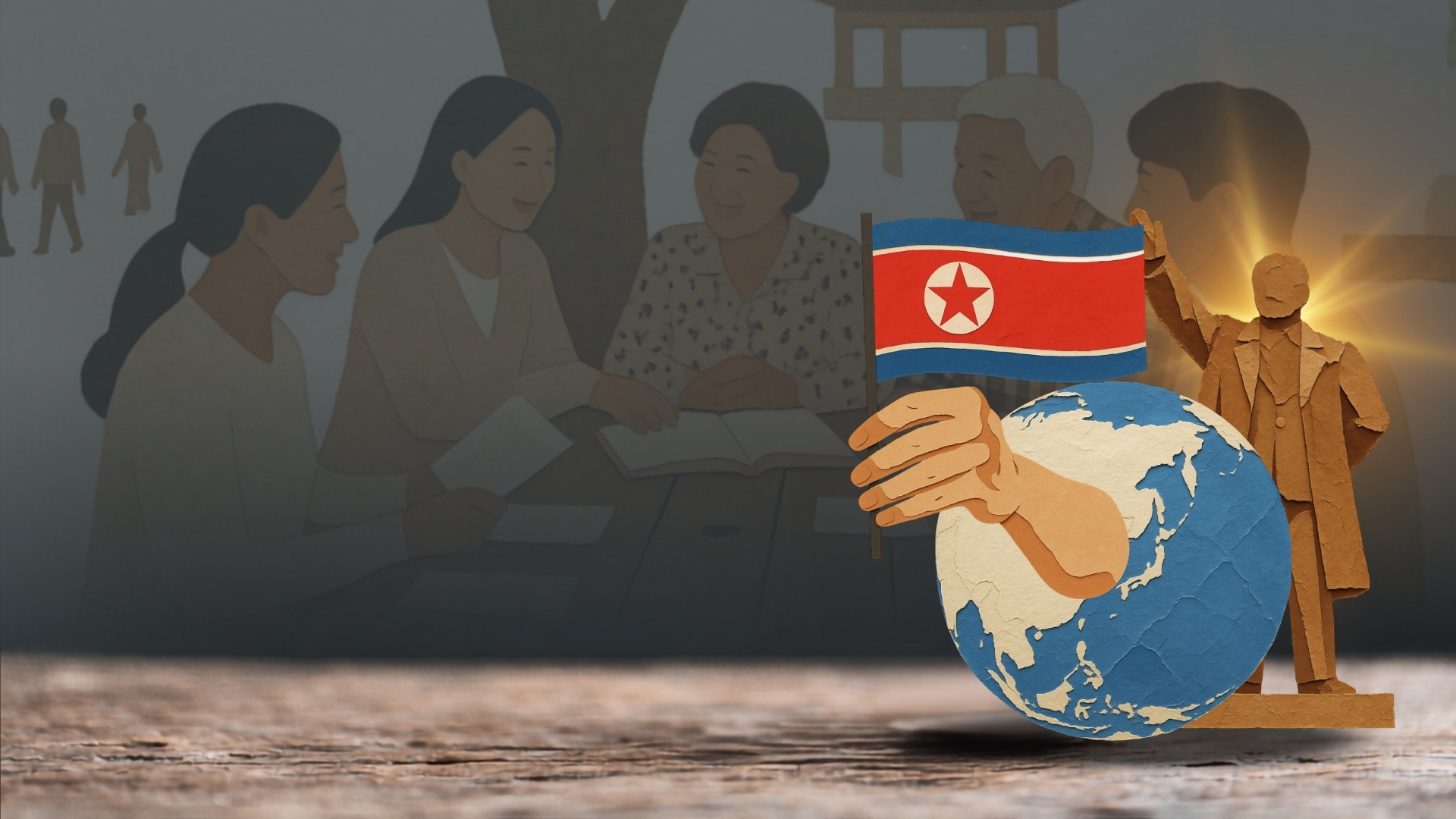

We live in a glocalised world. That means we can have neighbours, coworkers, and classmates from anywhere and everywhere – including North Korea. However rarely, men and women who have escaped one of the most closed and oppressive societies on earth may be in our midst. And, as Peter exhorts, “Always be prepared to make a defense to anyone who asks you for a reason for the hope that is in you” (1 Pet 3:15), the church must be ready for a circumstance such as this. Yet many believers may feel inadequately prepared to minister to North Korean diaspora individuals — and the cultural distance makes that preparation harder to come by.
scattered peoples carry their home cultures with them
This article serves as a companion to an earlier piece on North Korea mission, extending that discussion to mission ‘to’ the diaspora through culturally informed pastoral and missiological lenses.1 Diaspora missiology has long recognized that scattered peoples carry their home cultures with them and that ministry to diaspora communities requires both cultural attentiveness and cultural sensitivity.2 The ‘to’ mission pursued here carries added strategic weight, as diaspora North Koreans often maintain behind-the-scenes ties with family still inside the country, making them a potential conduit for the gospel — a ‘through’ mission — to one of the most unreached peoples on earth.3 Drawing on prior cultural analysis rooted in large-scale defector research, research on North Korean defector trauma and mental health, and Paul Hiebert’s missiological concept of the “excluded middle,” this article offers four practical approaches for Christians seeking to reach North Koreans in their midst.4

1. Indirect/High-Context Communication Style
North Korean culture reflects a highly indirect, high-context communication orientation.5 Meaning is not carried primarily through explicit words but through relationship, tone, context, and what is deliberately left unsaid. Speakers navigate conversations with careful attention to face-saving and social harmony. This pattern is already characteristic of broader Korean culture, but in North Korea, it was intensified by decades under a surveillance state in which speaking openly about doubt, dissent, or personal belief could carry severe consequences. Candor was a liability; caution became instinct. This caution is especially pronounced around sensitive topics such as political dissent, nonconformity, personal commitment, and belief.
For Christians engaging North Korean diaspora members, this has immediate implications. Direct evangelistic approaches — especially when used too quickly or without relational trust — can produce social performance rather than genuine engagement. A North Korean trained to manage external impressions may give the expected answer to relieve social pressure while remaining inwardly unmoved, and the missionary can mistake compliance for conversion. A more culturally intelligent approach builds relational trust before expecting explicit verbal responses, carefully discerns nonverbal cues (unusual silences, micro-expressions, subtle tone shifts) and uses open questions rather than only yes/no ones. Unhurried, consistent presence, joined with Christlike love and wise gospel sharing over time, can become an important form of witness.

2. Cultural Tightness/Looseness
North Korean culture reflects a highly tight social environment, where strong norms, surveillance, punishment, and pressure toward conformity have shaped how people speak, behave, trust, and respond to authority.6 Yet in diaspora, people formed in such an environment may enter freer social spaces without immediately feeling free. They may still guard their words, assess relational risk, or give answers that seem socially safe.
gospel communication should remain clear yet patient, relational, and non-coercive.
For Christians seeking to reach North Koreans in diaspora, gospel communication should remain clear yet patient, relational, and non-coercive. Direct questions and calls for response may be appropriate, but they should be grounded in relational trust, sensitivity to fear-shaped responses, and dependence on the Holy Spirit. Such patience does not soften the gospel; it helps North Koreans hear the truths of the gospel more fully without confusing gospel summons with coercion or outward conformity.

3. Trauma Awareness
The journey from North Korea to freedom is, in almost every case, a trauma narrative. Defectors have typically endured food insecurity, pervasive state surveillance, the grief of leaving family behind — often permanently — and in many cases dangerous escape routes through China and Southeast Asia carrying serious risks of exploitation, trafficking, and forced repatriation. Arrival brings its own disorientation: a different language, a radically different social environment, and the psychological weight of starting over with little support. Research consistently documents elevated rates of post-traumatic stress, depression, and difficulty forming trust among North Korean defector populations.7
Mission to the North Korean diaspora that is unaware of this reality can inadvertently cause harm. Church environments that move too quickly toward public testimony or performance-based belonging, or that model strong hierarchical authority can feel unsettlingly similar to the loyalty performances demanded by the totalitarian state. A trauma-aware approach creates safety before expectation, relationship before program, and healing before missional responsibility. The gospel’s promises of peace, adoption into a new family, and freedom from fear speak directly to what North Koreans carry — but are most fully heard when offered with patience and true caring presence.

4. Addressing the Excluded Middle
Many Christians, shaped by Western gospel presentations, tend to move quickly to the grand metanarrative — creation, fall, redemption, restoration — without addressing the lived, felt-need questions of everyday life. Missiologist Paul Hiebert called this “the excluded middle”: the layer of spiritual reality that Western Christianity tends to bypass but that many people experience as profoundly real and urgent.8 This middle layer includes questions about uncertainty, crisis, misfortune, disaster, fear, past hurts and unresolved suffering, spiritual powers, ancestors, and unseen forces that shape daily life.9 When Christianity ignores this layer, the gospel can feel incomplete or disconnected from actual life.
God speaks not only to the afterlife but to every dimension of life and suffering.
For North Koreans, these are not abstract concerns — they surface in survivor guilt over family left behind, identity disorientation, the struggle to belong, shame around cultural gaps, the exhausting labor of starting over, and a deep difficulty trusting others after a life shaped by betrayal. Beneath these press urgent theological questions — whether God was present during years of suffering, whether what was done to survive can be forgiven, whether they deserve belonging, and whether God still sees them in their isolation. Christians sharing the gospel with North Korean diaspora should therefore not be satisfied with presenting the major pillars of the biblical metanarrative in abstract form, but should bring the full counsel of Scripture to bear on these questions — showing that God speaks not only to the afterlife but to every dimension of life and suffering.
Why This Mission Is So Significant
First, this ministry can lead to a form of ‘through mission’. North Korea remains one of the most inaccessible nations on earth to outside missionaries. Yet diaspora North Koreans often maintain familial and cultural connections to people still living inside the country. A single North Korean reached in Seoul or Los Angeles may be the beginning of a chain of witness that crosses a border no outside missionary can currently cross.
Second, this mission holds continuity across whatever political changes lie ahead. The cultural realities shaping North Koreans in diaspora today — including communication patterns, cultural tightness, trauma-shaped concerns, and excluded-middle questions — are deeply ingrained and will not dissipate quickly even as circumstances shift.10 Whether the context is a diaspora community now or a newly accessible congregation after unification, the same cultural intelligence will be needed. The church that develops this awareness today will already be one step forward in preparedness for the missional movement that awaits.
Conclusion
The church must not assume that love for North Koreans requires goodwill alone; preparation, attentiveness, and Spirit-dependent witness are needed. The gospel is for everyone, every nation, every tribe, and every tongue (Rev 7:9). God sometimes sends unreached people to us, drawing us into his mission toward those we have long overlooked or could hardly imagine reaching in ordinary circumstances. Yet God may be sending some of those very people — having brought them through an oppressive regime and across dangerous borders — not only for their own salvation but also so that the gospel might travel back through them to save others in the land they left behind. In this sense, ministry to North Koreans in diaspora matters both as present witness and as preparation for the church when the door to North Korea opens more widely. The presence of a North Korean in your community should not be viewed only through geopolitics — it may also signal a providential invitation to join God’s mission to one of the world’s most unreached peoples.
Endnotes
- Soo Min (James) Park, “Missional Strategies for North Korea: Preparing the Global Church for the Post-Isolation Era,” Lausanne Movement, January 23, 2026, https://lausanne.org/about/blog/missional-strategies-for-north-korea.
- Enoch Wan, Diaspora Missiology: Theory, Methodology, and Practice (Portland: Western Seminary, 2011), 131–132, 223.
- Ibid., 20–21.
- Ministry of Unification, Report on North Korea’s Economy and Society as Perceived by 6,351 Defectors, by Lee Wooyoung, Ko Kwangyoung, Kim Sungkyung, Park Juhwa, Yang Moonsoo, Yu Youngsoo, Lee Chulsoo, and Cho Yongshin (Ministry of Unification, 2025), Government Publications Registration Number 11-1250000-000157-01.
Soo Min (James) Park, “Cultural Landscaping of North Korea: Preparing for Mission Engagement through Large-Scale Defector Insights on Economy and Society,” Great Commission Research Journal 18, no. 1 (2026): 41–55.
Woo-Taek Jeon et al., “Traumatic Experiences and Mental Health of North Korean Refugees in South Korea,” Psychiatry Investigation 5, no. 3 (2008): 213–220.
Paul G. Hiebert, “The Flaw of the Excluded Middle,” Missiology: An International Review 10, no. 1 (1982): 35–47. - Park, “Cultural Landscaping of North Korea,” 50–52.
- Ibid., 49–50.
- Jeon et al., “Traumatic Experiences,” 213–214.
- Hiebert, “Flaw of the Excluded Middle,” 35–47.
- Ibid., 43–45.
- Geert Hofstede, Gert Jan Hofstede, and Michael Minkov, Cultures and Organizations: Software of the Mind, 3rd ed. (New York: McGraw-Hill, 2010), 9; Park, “Cultural Landscaping of North Korea.”