




























The church has always carried the gospel through the communication worlds available to it. Roads, letters, printing presses, radio, film, & broadcast media have changed how Christian witness travels. Digital culture belongs within that story, but it is more than another tool. It is now a place where people live, question, search, and belong.
This report listens to global Christian leaders serving within a digital world. They share a deep conviction that digital mission matters. Yet strategy and theological reflection have not kept pace with its growing importance. Our ability to reach people has expanded faster than our capacity to turn that reach into intentional Great Commission work that forms disciples.
This tension gives the report its central movement: from digital presence to digital mission. The church recognizes the importance of the digital world, but confusion remains about what digital mission actually is. Too often, it is reduced to promoting Christian content and events to people already involved.
Digital mission must reach further. It should carry the gospel beyond our existing communities. It should invite response, cultivate discipleship, and connect people to the life of the church.
My hope is that these findings move us from recognition towards faithful action. The task is not simply to become more digitally capable. It is to bear faithful witness to Christ wherever people now gather.

Matthew Niermann, Ph.D.
Director of Global Research
Lausanne Movement
Report Team
California Baptist University
Lilly Glennie | Designer
Eliana Rotunno | Designer
Lydia Jung | Motion Designer
FROM DIGITAL PRESENCE TO DIGITAL MISSION

Digital life is no longer separate from everyday life. It shapes how people work, learn, build relationships, & understand the world. It also shapes how people encounter the Christian faith.
As more of life has moved online, churches & ministries have adopted digital tools to support their work. They stream worship, distribute Scripture, and share Christian content. Digital activity is now an ordinary part of ministry.
Yet much of this activity continues to serve people who are already connected to the church. Digital presence is not the same as digital mission.
Presence means showing up online. Mission begins when the church intentionally reaches beyond its existing community. It invites people to encounter the gospel, respond in faith, and grow as disciples. A ministry may attract attention online without creating a pathway towards any of these outcomes.
Global Voices: Digital Missions examines how the church can move from digital presence to digital mission. It draws on the experiences of Christian leaders from 70 countries.
These leaders agree that digital mission matters. However, many churches and ministries still lack a clear strategy for it. Investment remains limited, and theological reflection has not kept pace with digital change.
The findings suggest that the central question is no longer whether churches and ministries will use digital tools. They already do. The more pressing question concerns the kind of witness these tools are helping to create.
Leaders are asking whether proclamation can lead towards relationship and whether reach can contribute to formation. They are also considering how innovation can remain accountable to Scripture and guided by love of neighbor.


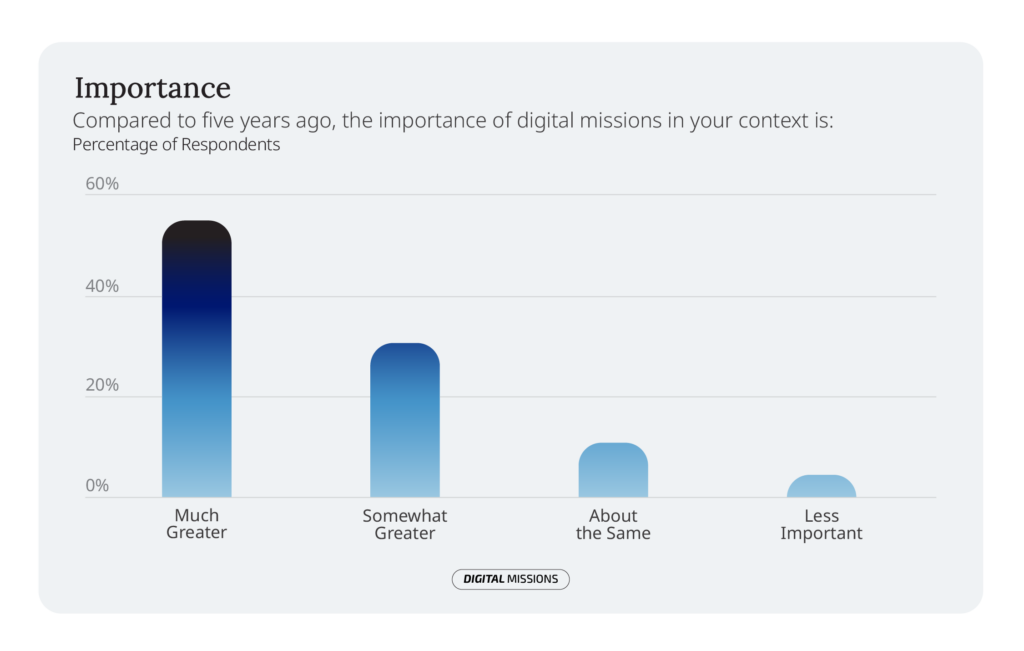
85% of leaders say digital mission is more important than it was five years ago.
1. DIGITAL MISSION IS NO LONGER PERIPHERAL
About 85% of leaders say digital mission is more important than it was five years ago, & they expect activity to keep rising. Digital spaces are becoming ordinary places of spiritual searching, Scripture engagement, evangelism, and Christian conversation.
The question is no longer whether digital mission belongs within the church’s calling. It is whether ministries will develop the wisdom and capacity to practice it faithfully.
2. RECOGNITION HAS OUTPACED INSTITUTIONAL RESPONSE
Nine in ten leaders agree that a digital missionary is an important role in the church. Institutional practice has not yet caught up. Major strategies remain uncommon, budgets are often absent or housed within communications, and trained teams are limited.
Conviction is present, but durable structures remain uneven. Leaders are being asked to innovate without the guidance or support needed for sustained mission.

9 in 10 leaders agree that a digital missionary is an important role in the church.

3/4 of leaders say digital mission efforts support existing ministries.
3. DIGITAL MISSION IS OFTEN CONFUSED WITH MARKETING
More than three-quarters of leaders say digital mission primarily supports existing ministry. Current practice reflects this through content, promotion, and broadcasting, often reaching people already connected to the ministry. Communication is not the enemy of mission. The problem arises when presence is assumed to be outward mission. Greater clarity begins by naming the intended audience, the response being invited, and the pathway towards formation.
4. INTENTIONAL STRATEGY SHAPES DIGITAL MISSIONS
Nearly half of ministries that treat digital mission as a distinct focus have a major strategy in place. That is about twice the share of ministries using digital tools mainly to support existing work. This relationship does not prove cause and effect, but it reveals an important pattern.
Strategy brings clarity. It helps leaders identify whom they hope to reach and what response they hope to encourage. It also connects digital activity to discipleship and Christian community. With greater intentionality, digital communication can become faithful Christian witness.

Nearly 1/2 of ministries that treat digital mission as a distinct focus have a major strategy in place.

4 in 5 leaders expect artificial intelligence to play a significant role in evangelism and mission.
5. AI IS EXPECTED BUT NOT INTEGRATED
Four in five leaders expect artificial intelligence to play a significant role in evangelism and mission. Yet current use often remains limited to content creation. Expectation is moving faster than integration.
Leaders are open to AI, but their support is tied to theological & ethical frameworks. Ministries need judgment, safeguards, contextual awareness, and missional purpose before efficiency becomes the measure of responsible use.
6. THE FUTURE OF DIGITAL MISSION REMAINS HUMAN
Nearly half of leaders name the loss of human presence as a primary concern. Their responses return to personal follow-up, local church connection, small groups, contextualized content, equipped believers, translation, and responsible innovation.
The future they imagine is not digital instead of embodied. Technology may extend reach and cross borders. Mission becomes Christian witness when people are known, accompanied, formed, and invited into the life of Christ and his people.

Almost 1/2 of leaders name the loss of human presence as a primary concern.
A SHIFT ALREADY UNDERWAY
Digital mission is no longer developing at the margins of mission practice. Across contexts, it is becoming more important, more active, and more closely integrated into the work of churches and ministries. This is not simply a response to one moment or the adoption of a particular technology. It reflects a wider change in where mission now happens and how Christian witness is carried into the settings where people communicate, search, and build relationships.
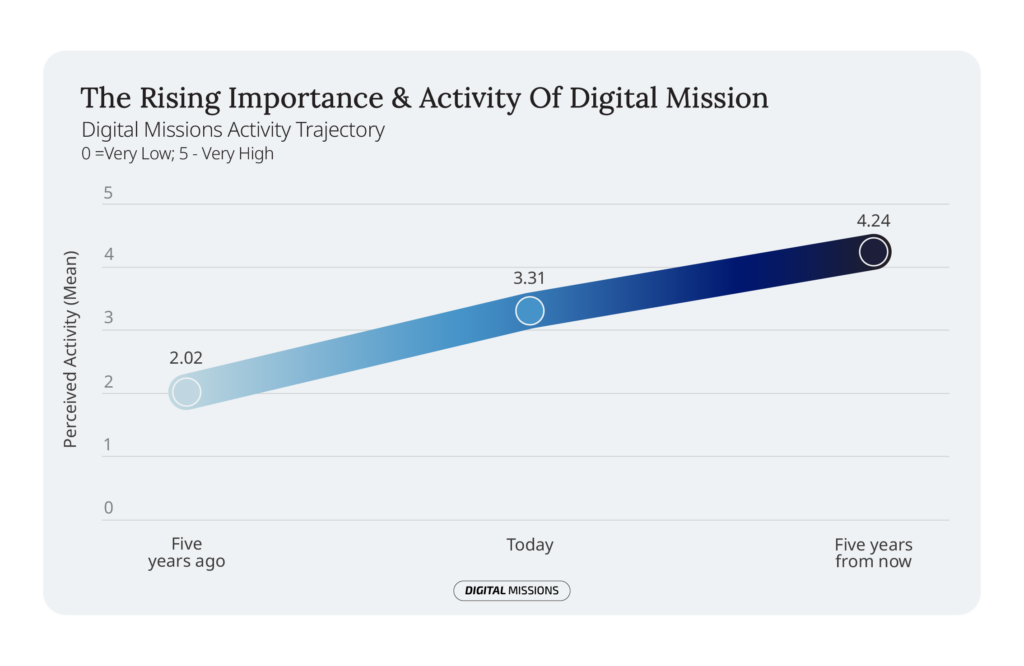
The leaders in this study recgonize that shift. About 85% say digital mission is more important in their context than it was five years ago. More than half describe its importance as much greater. Their assessment of activity follows the same direction. Perceived activity rose from five years ago to today. Leaders expect it to reach even higher levels of activity five years from now.
The transition remains incomplete, but momentum is building. Digital mission is becoming harder to treat as a specialised interest or temporary response. It is moving towards the ordinary work of evangelism and Scripture engagement. It is also becoming a setting for discipleship & Christian presence.
HOPE WITH CAUTION
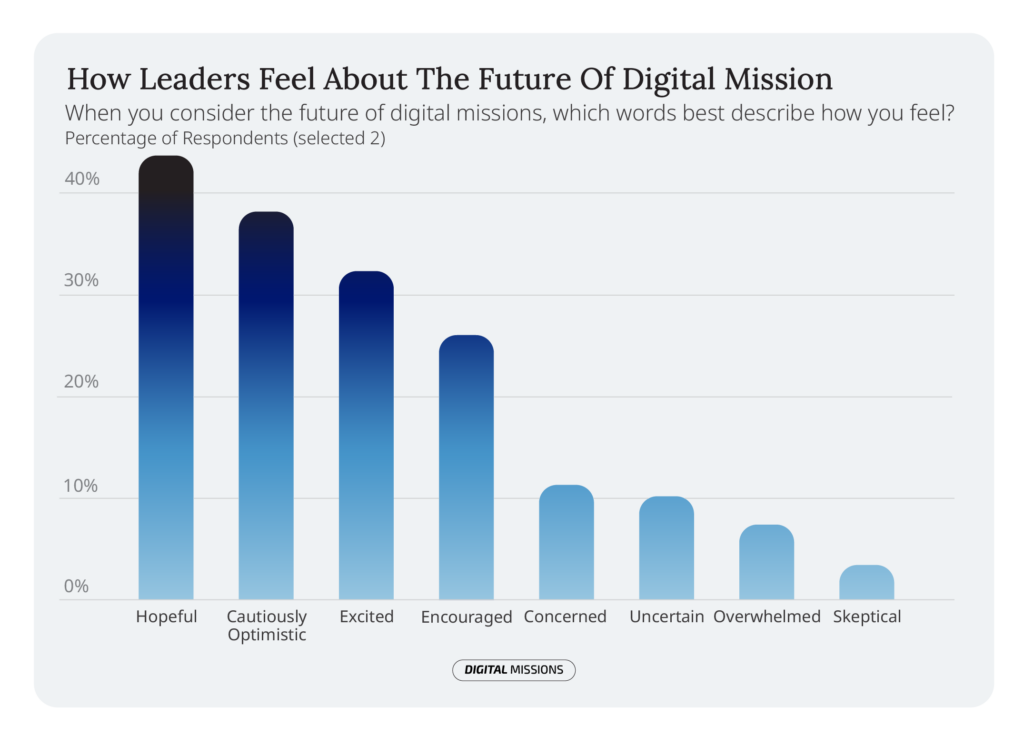
Leaders approach this future with more hope than fear. Hopeful is the most common word selected. Cautious optimism follows closely, with many also expressing excitement or encouragement. Some leaders remain concerned or uncertain. A smaller group is skeptical. These responses do not define the overall posture, which is one of possibility tempered by discernment.
Both hope and caution are needed. Uncritical enthusiasm can confuse novelty with faithfulness. Caution without imagination can leave the church absent from places where people are already searching, forming relationships, and asking spiritual questions.
The responses suggest a different posture: open to what digital mission may make possible, yet aware that tools do not determine the character of their use.
Hope also changes the questions leaders are willing to ask. A defensive posture asks how the church can preserve familiar forms of ministry as culture changes around it. A missional posture begins elsewhere. Where are people gathering? What burdens do they carry? How might Christian witness meet them there?
This does not require abandoning established practices. It requires seeing digital engagement as more than distribution. Leaders imagine wider access and better translation. They see possibilities for personal conversation and collaboration across distance.
Their hope is not that technology will accomplish mission for the church, but that it may open spaces in which faithful mission can occur.
DIGITAL MISSION IS BECOMING ORDINARY
Digital mission is sometimes discussed as though it occurs in a location separate from ordinary life. Yet the boundary between online and offline experience has become increasingly porous. A conversation may begin through a message and continue in a home.
Scripture may first be encountered through an app and later explored within a church. A digital community may connect someone who is isolated or displaced. It may also reach a person searching beyond familiar Christian institutions.
This does not make every digital activity missional. It does mean the church can no longer define mission only by physical movement. Crossing a border may involve geography. It may also require movement across culture or language. Sometimes the boundary is trust. In other settings, the barrier is access. Digital spaces create new forms of proximity while revealing new distances between people.
The responses point towards a challenge larger than increasing digital output. Leaders increasingly recognize digital culture as a setting for human encounter and Christian witness. They see substantial opportunity within these spaces, but they also recognize the responsibility that accompanies it. The church is already present online. The findings invite further reflection on the purpose and character of that presence.
Digital mission is becoming harder to treat as a specialized interest or temporary response. It is moving towards the ordinary work of Christian witness.

More than four in five believe digital mission deserves the same seriousness as cross-cultural physical mission.
A QUESTION OF LEGITIMACY
Calling an activity mission gives it theological significance. Mission describes participation in God’s work of making Christ known and forming disciples. For some churches and ministries, applying this language to digital engagement may still feel unfamiliar. The survey suggests, however, that most leaders have moved beyond debating whether digital mission can be real mission.
Nine in 10 respondents agree that a digital missionary is an important role in the church. More than four in five believe digital mission deserves the same seriousness as cross-cultural physical mission. These findings do not suggest that digital and physical mission are identical. They show that leaders consider both worthy of serious attention, investment, and theological reflection.
These responses show broad openness across the sample. Digital mission is not generally dismissed as a temporary practice or a contradiction in terms. Leaders recognize that Christian witness can cross digital boundaries as well as geographic ones.

CHURCHES ARE OPEN TO DIGITAL MISSION
Respondents describe a mixed picture of their churches’ openness to digital mission. About six in 10 disagree that their church is cautious or resistant toward digital mission. Just under half say their church encourages members to engage digitally for mission.
The two findings offer complementary perspectives. Leaders do not simply express personal support for digital mission. Most also perceive openness within their churches. This suggests that widespread resistance is not the primary obstacle facing the field.
Openness, however, does not necessarily indicate that churches have developed a clear strategy. A church may encourage members to engage online without providing training or defining what missional engagement looks like. It may recognize digital mission while remaining uncertain about leadership and funding.
These questions appear later in the report. Here, the findings establish that many churches appear willing to explore the field.
Leaders broadly accept digital mission as a legitimate expression of Christian witness. They are less settled on how that conviction should shape ministry practice.

DEFINING THE WORK
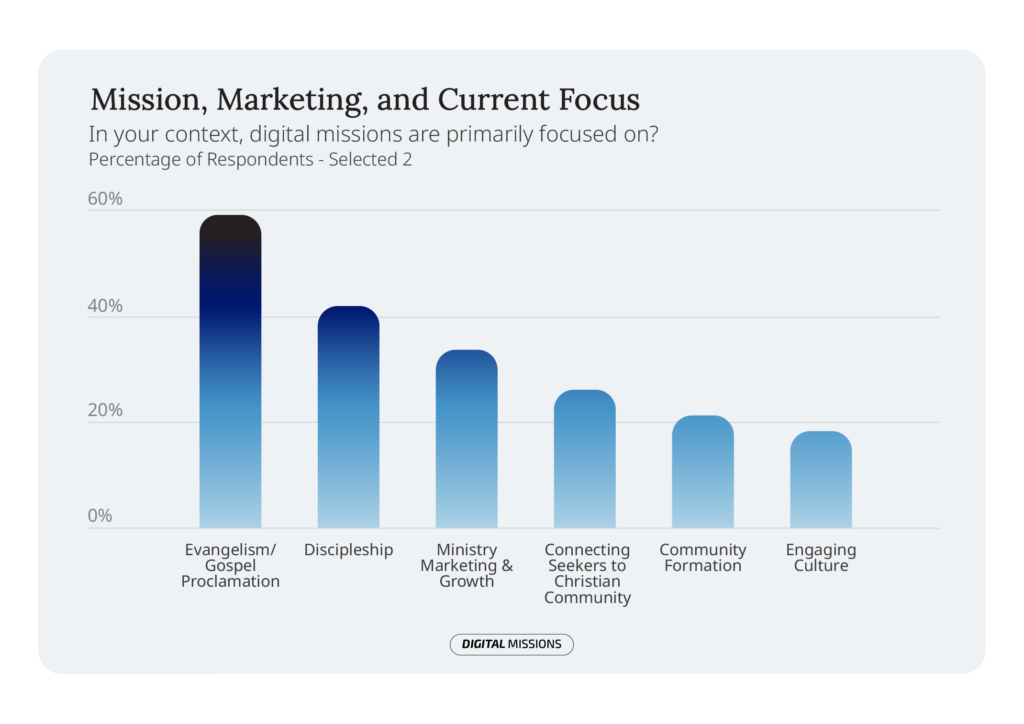
Broad acceptance does not mean leaders share one definition of digital mission. When asked to select the best description, just over half emphasized proclaiming the gospel through digital channels. About one-third emphasized forming disciples through digital engagement. A smaller group focused on connecting people with physical Christian community.
These responses reveal different points of emphasis. Some leaders begin with proclamation. Others give greater attention to formation or belonging.
The results do not show that these aims are mutually exclusive. Instead, they suggest that digital mission is still developing a shared language for how gospel encounter, discipleship, and Christian community relate to one another.
This also helps explain the growing recognition of digital missionaries. Leaders appear to associate the role with more than technical skill. Their responses point toward cultural understanding and Christian witness. They also emphasize relationships and connections between digital engagement & further spiritual growth.

ACCEPTANCE AHEAD OF CLARITY
Chapter 2 reveals a field that has gained legitimacy before reaching complete clarity. Leaders broadly affirm digital mission. They recognize the role of digital missionaries and report little resistance within their churches. Yet they continue to emphasize different purposes and outcomes.
This creates the next question for the report. Leaders largely agree about what digital mission can be. The following chapter examines whether current ministry practice reflects that understanding.
WHAT CURRENT PRACTICE REVEALS
Churches and ministries use digital tools every day. They publish teaching and share updates. They stream services and promote events. These practices strengthen existing communities and make Christian resources more accessible.
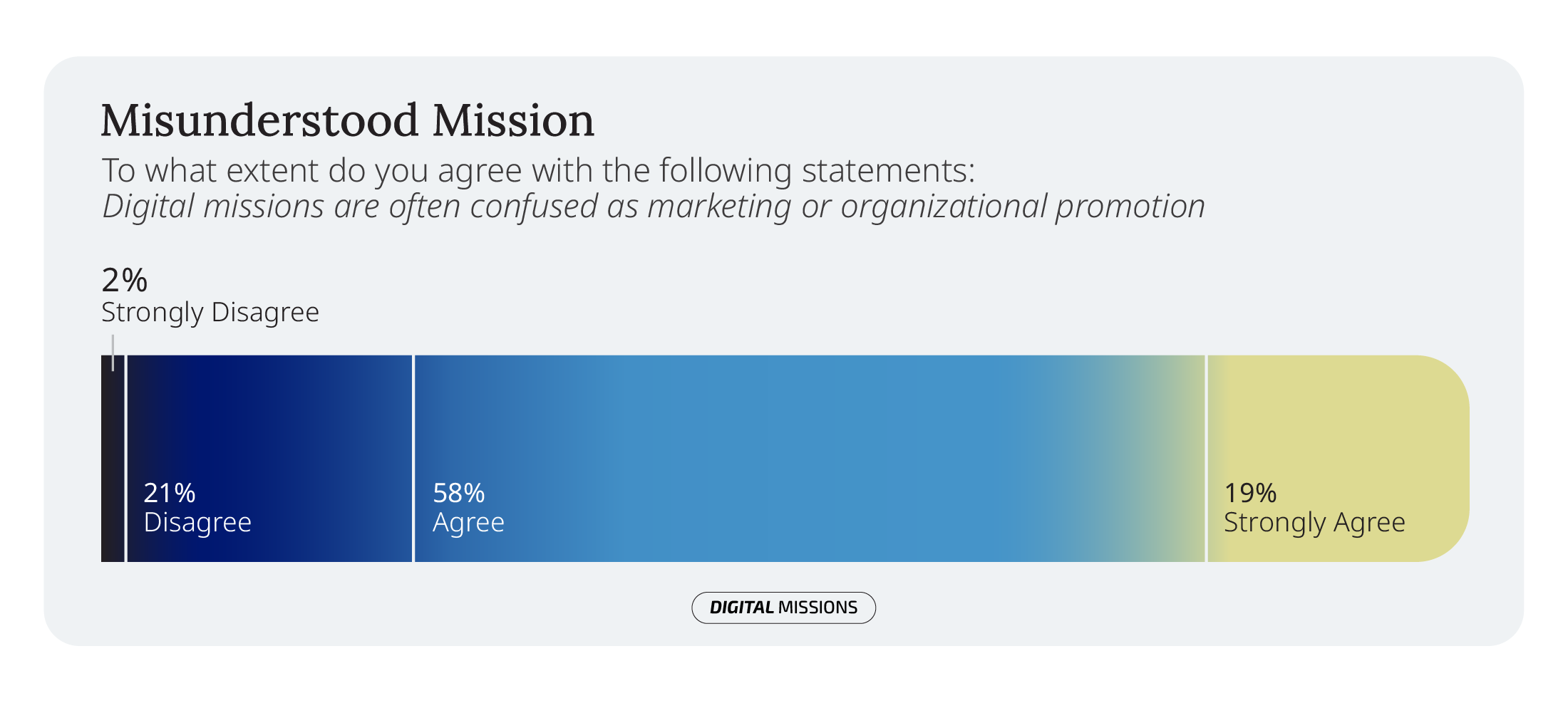
Leaders nevertheless see a need for greater clarity. Nearly four in five agree that digital mission is often confused with marketing or organizational promotion. A similar share says digital mission currently functions primarily as a tool supporting existing ministry rather than as a distinct missional focus.
The confusion is understandable. The same website or social platform can be used for several purposes. A ministry may announce an event and share a testimony in the same feed. A church may stream a service for its members while also reaching someone with no connection to the congregation. The technology does not reveal the purpose on its own.
The findings suggest that leaders distinguish these activities by looking at the people being served and the response being invited. Communication often supports an existing relationship. Marketing commonly draws attention to an organization or opportunity. Digital mission is more often associated with gospel engagement beyond an established community.
HOW MINISTRIES USE DIGITAL ENGAGEMENT
The pattern becomes clearer when leaders describe how their ministries use digital engagement. Content for members or supporters is the most common activity. Broadcasting services or events follow closely. Recruiting participants and promoting ministry opportunities are also common. By comparison, only one in four leaders says their ministry primarily uses digital engagement to reach unfamiliar or unreached people.
This does not diminish the value of serving people already connected to a ministry. Teaching and encouragement remain important parts of Christian ministry. It does show that much current digital activity functions as communication within an existing community.
The results also help explain why leaders may use the language of digital mission differently. Some apply the term broadly to nearly any Christian activity online. Others reserve it for engagement intended to cross a cultural or relational boundary. The survey does not settle that definition, but it reveals why the distinction matters to respondents.
THE AUDIENCE ALREADY NEAR US
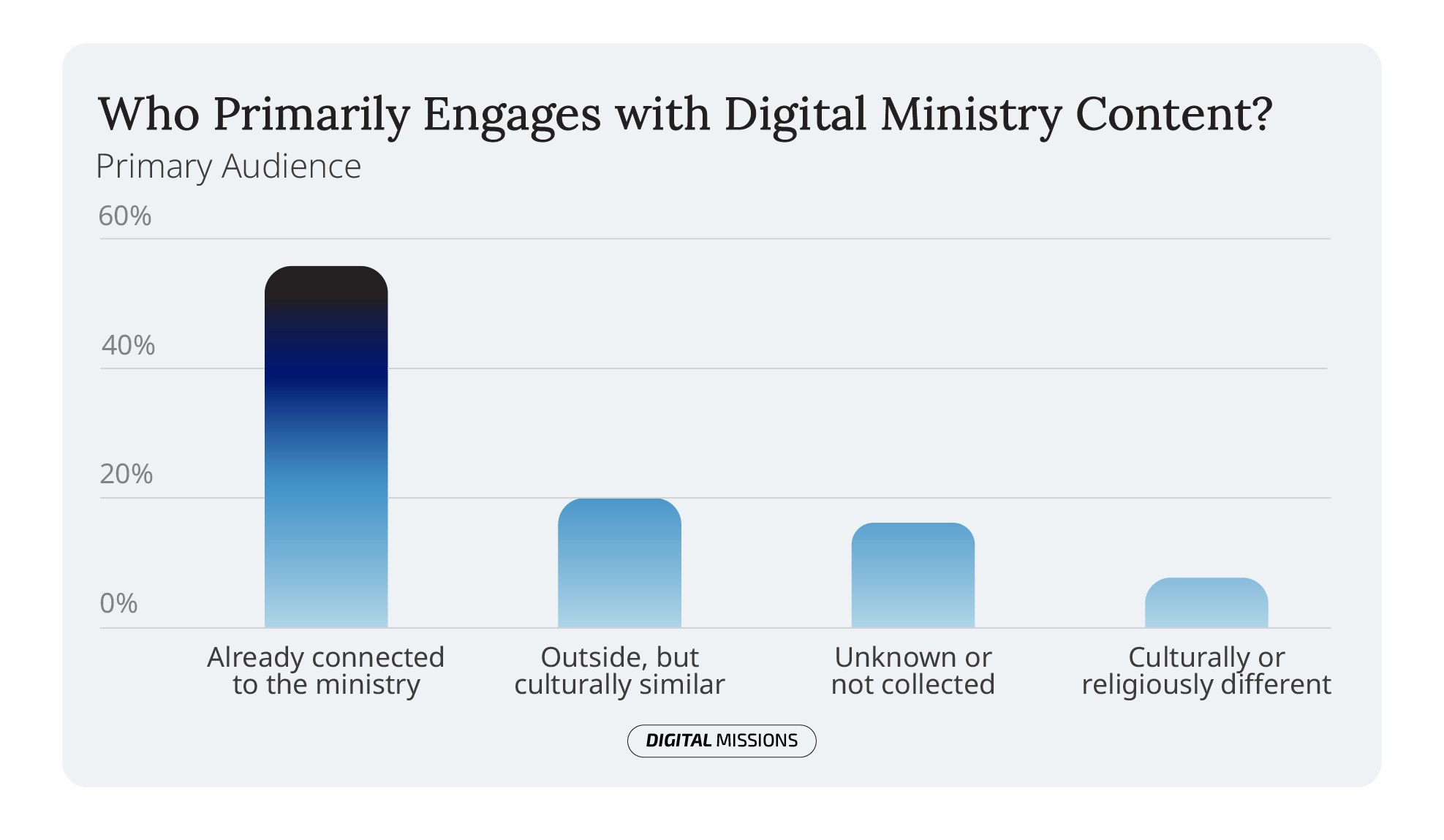
Audience data reinforces this pattern. More than half of leaders say the people engaging with their digital content are already connected to the ministry. About one in five primarily reaches people outside the usual community who remain culturally similar. Only a small minority identifies people who are culturally or religiously different as the primary audience.
This gap does not necessarily indicate a lack of missional concern. It may reflect limited data or the way platforms distribute content. It may also show how difficult it is to reach beyond an established network.

The findings invite ministries to examine whether the audience they hope to reach is the audience currently engaging.
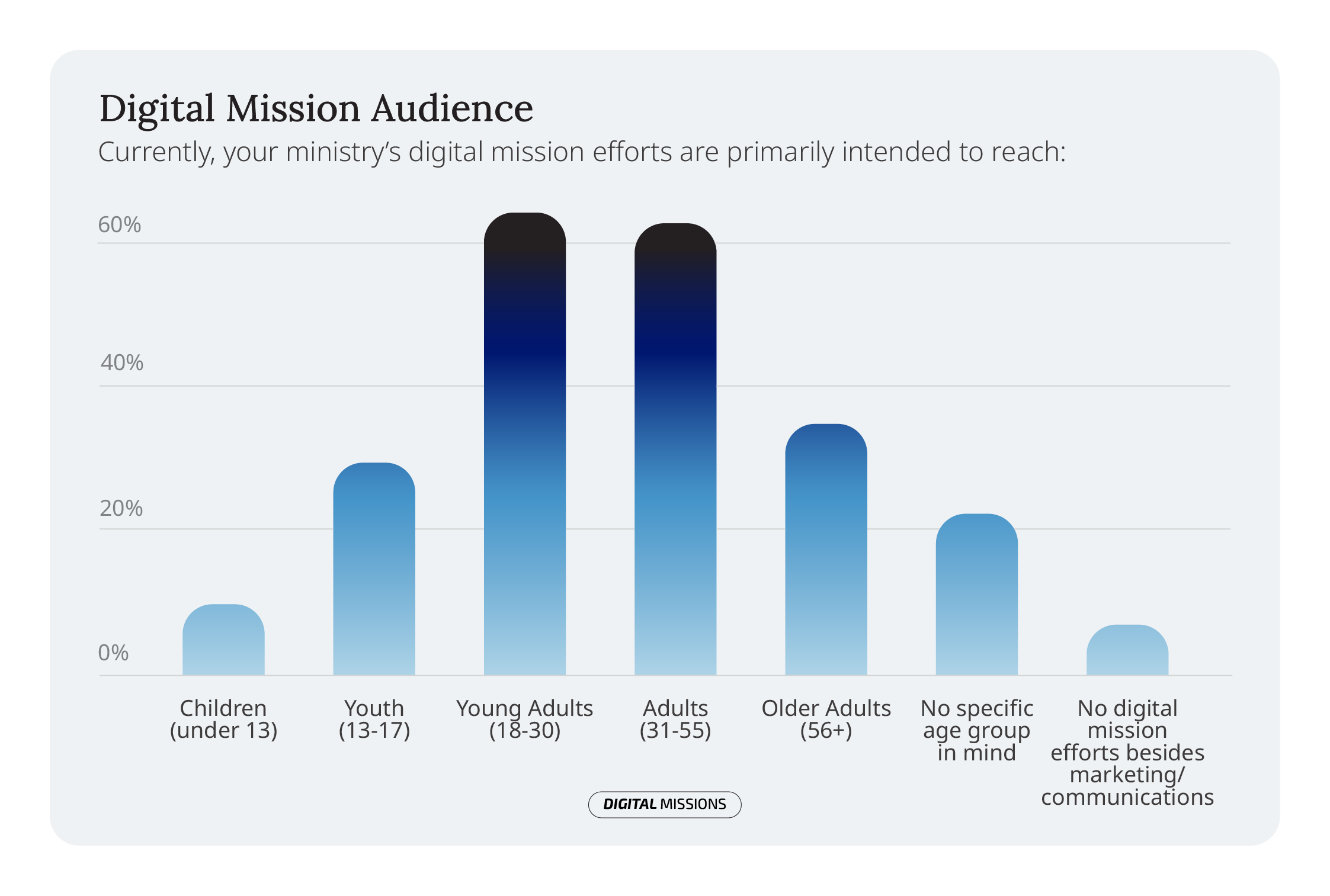
Another group cannot say who is being reached because the necessary data is not collected. This uncertainty makes it difficult to determine whether content is traveling beyond familiar Christian networks. A post may reach many people while remaining concentrated among existing members or supporters. There is also a contrast between intended and actual audiences. Many ministries describe a broad intended audience. Young adults and adults are named most often, but the stated reach is rarely narrow.
Actual engagement appears more concentrated among people who are already close to the ministry.
HOW LEADERS DISTINGUISH THE WORK
Leaders who describe digital mission as outward facing tend to begin with the people they hope to serve. Their responses raise questions about who is absent from a ministry’s current audience and what barriers may keep people distant from Christian community. This suggests that audience awareness may be an important step in moving from general communication towards more intentional mission.
Leaders associate outward-facing digital mission with conversation and response rather than visibility alone. In their descriptions, content can introduce an invitation or create an opportunity for further engagement. These responses suggest that leaders distinguish digital mission partly by what happens after someone encounters the content.
A ministry may have a large digital audience and still speak mainly to people who are already involved. Mission begins with the intentional turn towards others.
The findings do not diminish the importance of marketing or communication. Both can support the work of churches and ministries. The distinction appears to concern direction & purpose. Some digital activity strengthens an existing community, while other activity seeks to engage people beyond it. Greater clarity about these purposes may help ministries understand the role each form of activity plays.

Digital engagement can place Christian content before people. The harder work is helping that encounter become discipleship and community.
REACH IS A BEGINNING
Digital tools are effective at carrying content. They can place Scripture in a person’s hands within seconds. They can introduce the gospel across distance and make Christian teaching available at any hour. Leaders recognize these strengths. Nearly three-quarters consider digital engagement effective for Scripture engagement. More than two-thirds say the same for evangelism and gospel proclamation.
These are meaningful opportunities. Access matters, especially where churches are scarce or Christian witness is restricted. A video may answer a question that someone cannot ask publicly. An app may offer Scripture in a language that has few printed resources. A private message may create a first point of contact with a Christian.
The findings also reveal uncertainty about what follows initial reach. Encountering content may lead to understanding or further exploration, but the survey does not show what happens next. Leaders appear less confident about discipleship and community formation than they are about proclamation and Scripture engagement. This difference points towards a possible gap between initial contact and longer-term formation.

WHERE FORMATION BECOMES HARDER
Leaders are less confident about what happens after initial engagement. About half describe digital engagement as effective for discipleship. Confidence falls further for community formation. The contrast reveals a basic challenge. Leaders appear more confident in the ability of digital tools to carry information than to cultivate belonging.
Discipleship develops through more than access to good content. It requires trust and practice. People need guidance as they learn to follow Jesus. They also need relationships that can respond to their questions and recognize growth over time. Christian community adds shared worship and service. It places faith within the life of the body of Christ.
Leaders see several ways digital environments can contribute to formation. They mention conversation and connection across distance. They also describe online groups in settings where physical gathering is difficult. At the same time, the responses frequently return to personal follow-up and relational accompaniment. This suggests that leaders understand content as one part of formation rather than its complete expression.
The responses suggest that relational capacity may be as important as technical capacity. Ministries may produce strong content while remaining uncertain about how to respond when someone asks for help. They may invite conversation without having an established process for follow-up. Leaders repeatedly identified trained people and clear responsibility as important needs. These concerns indicate that the formation gap may involve not only content, but also the ministry structures surrounding it.

WHAT MINISTRIES CHOOSE TO MEASURE
The formation gap also appears in how ministries define success. Meaningful conversation is the most common primary measure. That is encouraging because it moves beyond passive attention. Yet nearly one-quarter of ministries have no clear metrics. Others rely mainly on reach or follower counts. Fewer than one in 10 use clear discipleship milestones.
Metrics do not describe the full journey of discipleship, but they reveal what a ministry has learned to notice. When success is defined by impressions, activity tends to be shaped for visibility. When success includes conversation and formation, ministries begin to design for response. They ask whether people are returning & whether relationships are developing.
They look for evidence that Scripture is being understood and practiced. The findings do not suggest that every spiritual journey can be reduced to a dashboard. Formation is personal and often difficult to measure. They do suggest, however, that the measures ministries choose reveal what they are prepared to notice.
Clearer attention to conversation and discipleship may help ministries learn what happens after initial reach and whether people are finding meaningful next steps.he formation gap also appears in how ministries define success. Meaningful conversation is the most common primary measure. That is encouraging because it moves beyond passive attention. Yet nearly one-quarter of ministries have no clear metrics. Others rely mainly on reach or follower counts. Fewer than one in 10 use clear discipleship milestones.
Metrics do not describe the full journey of discipleship, but they reveal what a ministry has learned to notice. When success is defined by impressions, activity tends to be shaped for visibility. When success includes conversation and formation, ministries begin to design for response. They ask whether people are returning & whether relationships are developing.
They look for evidence that Scripture is being understood and practiced. The findings do not suggest that every spiritual journey can be reduced to a dashboard. Formation is personal and often difficult to measure. They do suggest, however, that the measures ministries choose reveal what they are prepared to notice.
Clearer attention to conversation and discipleship may help ministries learn what happens after initial reach and whether people are finding meaningful next steps.
Reach tells us that someone encountered the content. Formation asks what happened next and whether anyone was there to accompany the response.

EXPECTATION IS RUNNING AHEAD
Artificial Intelligence has entered ministry conversations quickly. Tools that once felt experimental now assist with many functions of work and ministry. New capabilities continue to appear before churches have had time to decide how they should be used.
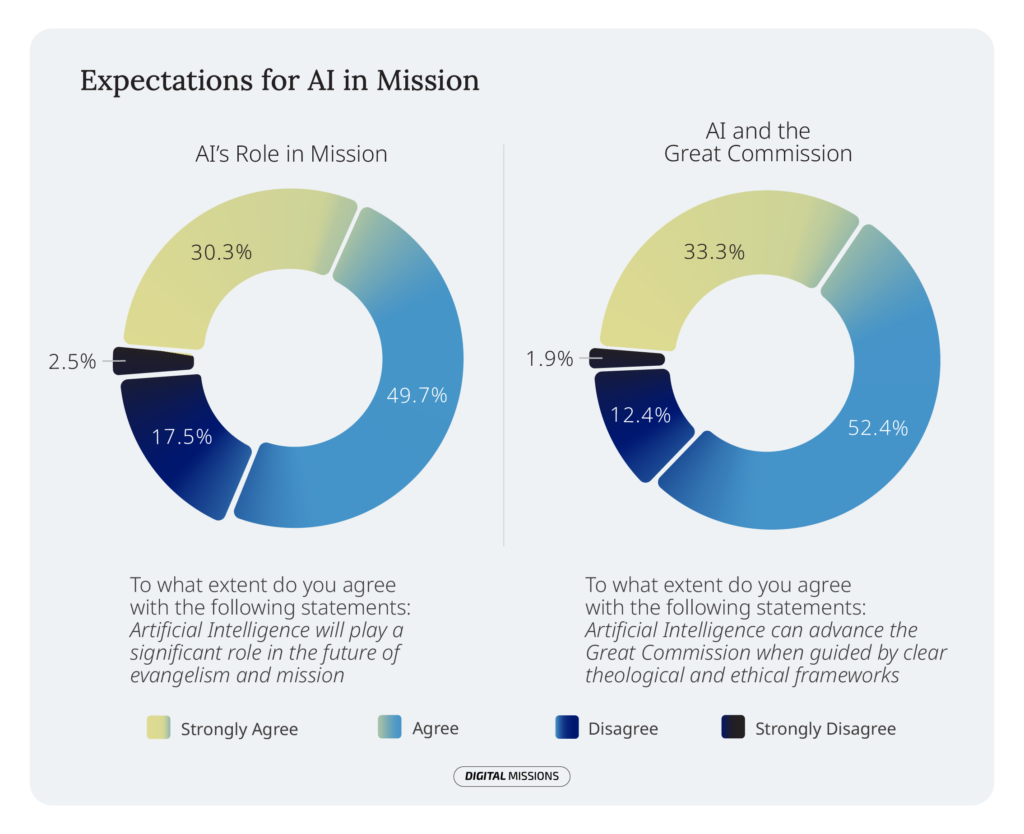
Leaders expect AI to matter. Four in five agree that it will play a significant role in the future of evangelism and mission. An even larger share believes it can advance the Great Commission when guided by clear theological and ethical frameworks.
This is not a simple endorsement of technology. The support includes a condition. AI should serve mission within boundaries shaped by Christian conviction.
The strength of this expectation makes the current moment important. Decisions made now may shape how ministries understand responsible use later. The church is not only choosing tools. It is forming habits of trust and judgment that will influence future practice.
CURRENT PRACTICE REMAINS NARROW
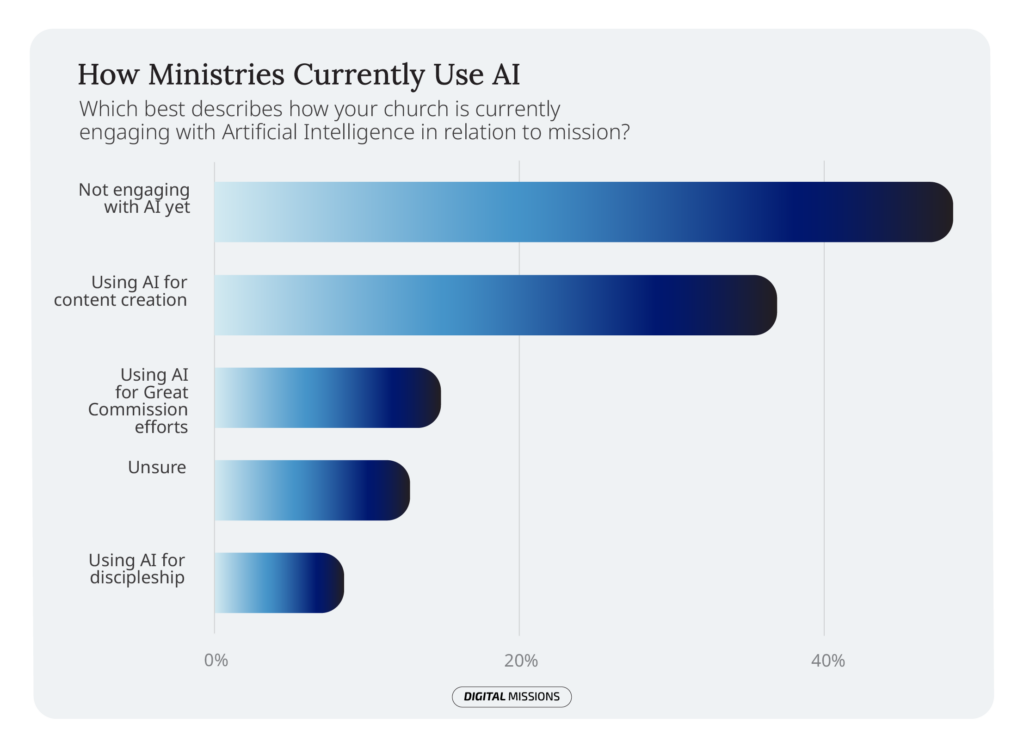
Expectation is high, but integration remains early. Nearly half of ministries report no engagement with AI. Among those using it, content creation is the most common application. Far fewer use AI directly for Great Commission efforts. Its use in discipleship is rarer still.
This pattern is understandable. Content creation offers an immediate entry point. AI can help a team draft material or adapt language for a new audience. It can reduce the time required for routine tasks. These uses are visible and easy to test. Mission-oriented applications are more difficult. They raise questions about human response and cultural context. They also require clarity about what the ministry hopes the technology will accomplish.
The gap between content use and direct missional use raises an important question about effectiveness. AI may help ministries produce more material, but the survey does not show whether that increase leads to gospel engagement or discipleship. Leaders appear interested in AI’s potential while remaining cautious about its outcomes. Their responses suggest that the value of AI will depend partly on how it supports wider ministry purposes and human relationships.
Leaders are not only asking what AI can produce. They are asking whether it can support Christian mission while preserving truth, trust, and human presence.
THEOLOGICAL AND ETHICAL GUIDANCE
Participant responses to open ended questions about AI show that leaders are not asking only what AI can do. They are asking what it should do. They want theological frameworks that clarify the place of human agency. They also want ethical guidance for privacy and truth. These concerns become more urgent when tools operate across languages or within settings where people face surveillance & persecution.
The responses suggest that leaders evaluate AI in relation to its purpose rather than its capabilities alone. They are attentive to whose voices may be amplified and which contexts may be misunderstood. Human review also appears frequently in their concerns, particularly when AI-generated content interprets Scripture or offers spiritual guidance.
Respondents also recognize that AI systems may reproduce cultural assumptions or present uncertain information with confidence. These risks are particularly significant in mission, where translation and theological interpretation depend on context. Leaders therefore connect the future use of AI with human judgment and theological maturity. Their concerns indicate that confidence in the technology will depend partly on whether ministries can evaluate its output within the cultures and communities they serve.
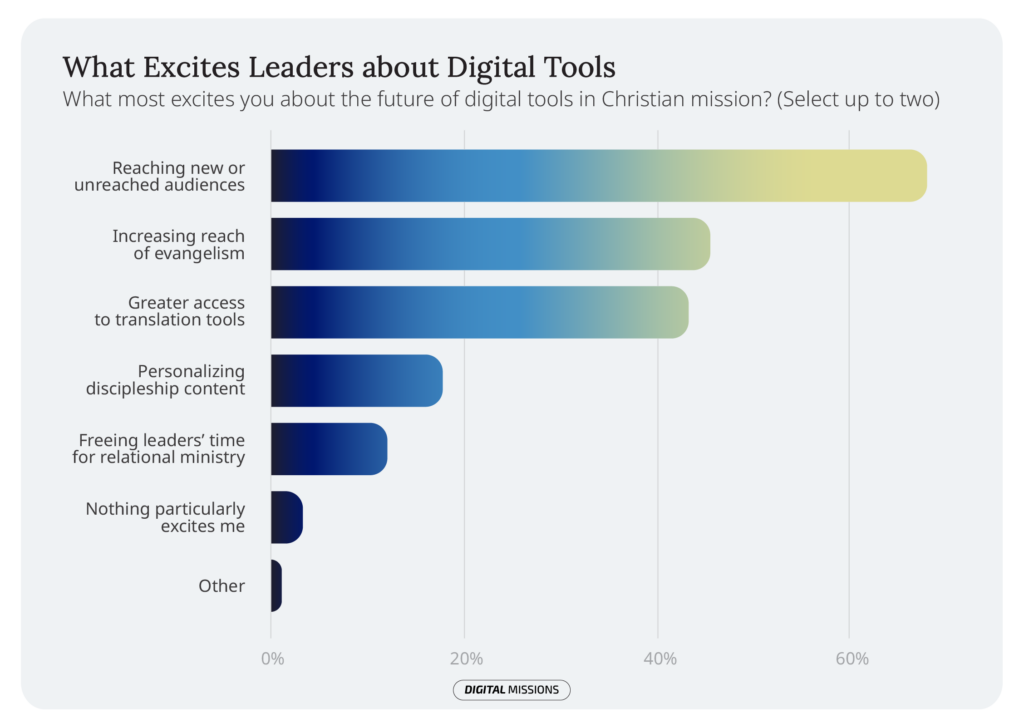
Leaders remain hopeful about the possibilities. They see AI expanding access to translation and helping ministries reach new audiences. They also believe it may reduce routine work and allow more time for relational ministry. Yet this hope is accompanied by caution. Across the responses, enthusiasm for greater capability is consistently joined to a desire for theological wisdom and ethical discernment.

Ministries with a clear digital mission strategy report a different pattern of practice. Purpose appears to shape what they notice and pursue.
STRATEGY CHANGES THE QUESTIONS
Digital activity often grows before a strategy exists. A ministry begins streaming because people need access. A social channel expands because someone has the skill to manage it. Over time, these practices become normal. Yet the ministry may never decide what missional purpose they are meant to serve.
Strategy appears to provide ministries with an opportunity to examine how their digital activities relate to one another. It can clarify the audience a ministry hopes to reach and the response it hopes to encourage. It may also help leaders consider who will respond when someone asks for help or wants to take a next step. The survey cannot establish that strategy produces these outcomes, but it shows a consistent association between intentionality and clearer practice.
Only about three in 10 ministries report a major digital mission emphasis supported by strategy and resources. Others describe a minor emphasis or early exploration. Some have no intentional strategy at all. The result is a field with strong conviction but uneven preparation.

INTENTION MADE PRACTICAL
An effective strategy does not need to be complicated. It should name the people a ministry hopes to serve. It should define the response being invited and the next step being offered. Someone should be responsible for follow-up. The ministry should also decide how it will learn from what happens.
This kind of clarity changes digital mission from an activity into a discipline. It aligns communication with purpose. It connects investment to outcomes and places innovation within accountable leadership. Strategy does not replace prayer or dependence on the Holy Spirit. It helps a ministry steward its opportunities with greater faithfulness.
Intentionality gives conviction a practical form and makes future learning possible.

A DIFFERENT PATTERN OF PRACTICE
Ministries with a major strategy appear more outward-facing. Nearly two in five say their primary audience is outside their existing community. Among ministries with no intentional strategy, the share is closer to one in 10. The pattern shows that ministries with a major strategy report a more outward-facing audience.
Differences also appear in measurement. Ministries with a major strategy are less likely to say they lack clear success metrics.
They report greater confidence in their ability to use digital tools wisely. They are also more likely to use AI for Great Commission efforts or discipleship rather than content creation alone.
These relationships do not establish cause and effect. A ministry may develop a strategy because it already has stronger leadership or more resources. The data does show a consistent association. Intentional strategy accompanies clearer measurement and greater outward focus. It also accompanies confidence and more mission-oriented experimentation.
THE CAPACITY BEHIND INTENTION
A strategy cannot remain a statement of aspiration. It requires people who can carry it. Lack of trained leaders is the most common barrier named in the survey. Limited funding follows. Many leaders also remain unsure about what works. These obstacles explain why recognition alone has not produced mature practice.
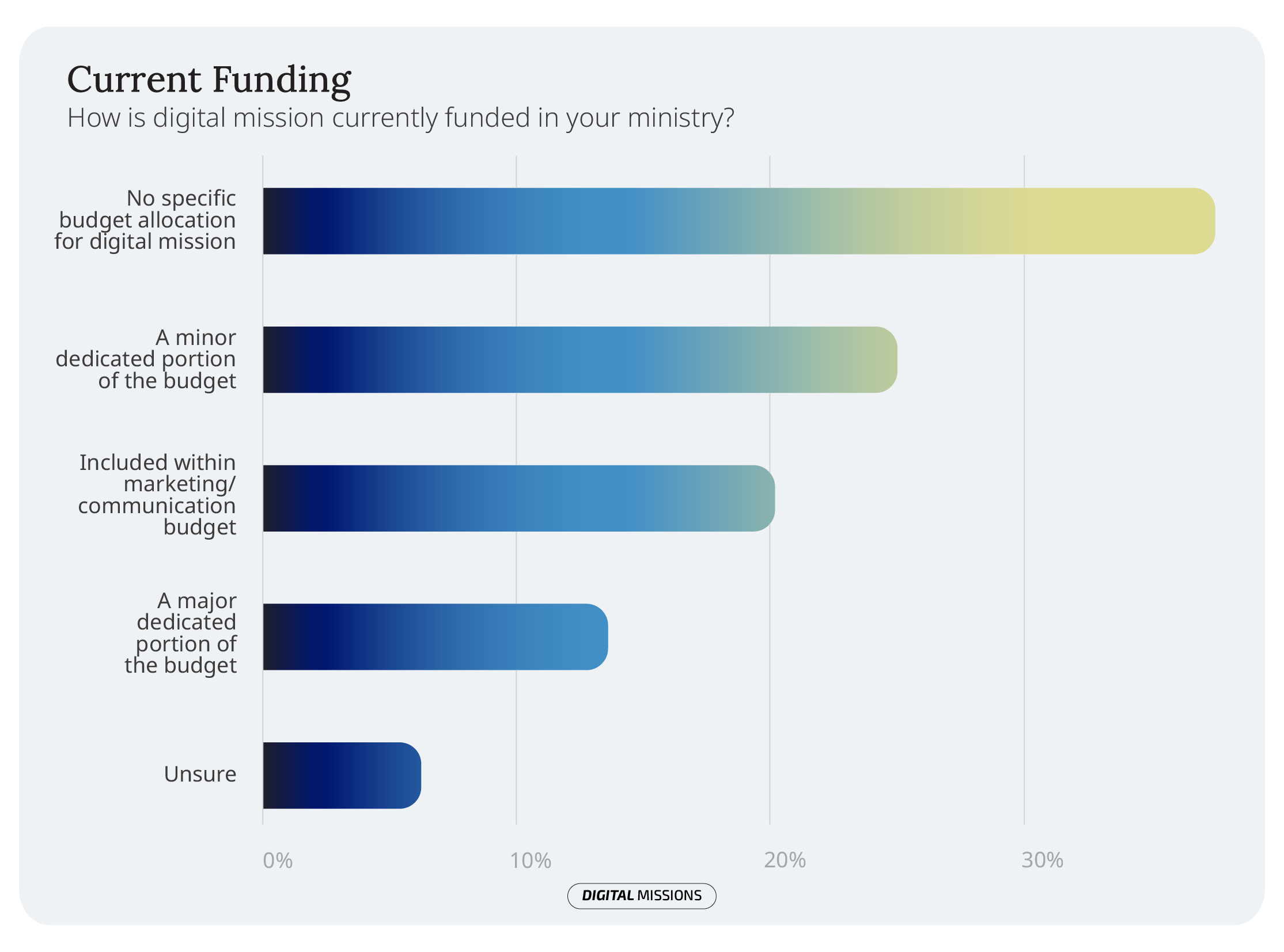
Funding reveals the same tension. More than one-third of ministries have no specific budget for digital mission. Others fund it through marketing or communication. This can reinforce the assumption that digital mission is mainly a publishing function.
A dedicated budget does not guarantee missional practice, but it makes priorities visible and gives leaders room to build capacity.
Strategy does more than organize digital activity. It helps a ministry decide whom it is serving, what response it is inviting, and how it will accompany what happens next.

The church also needs to equip ordinary believers. Digital witness cannot depend only on specialists. Members already inhabit online spaces through work and relationships. A strategy should help them recognize these spaces as contexts for Christian witness. It should give them practical guidance and pastoral support.


Only about clear 3 in 10 ministries report a major digital mission emphasis supported by strategy and resources.
HOPE WITH CLEAR EYES
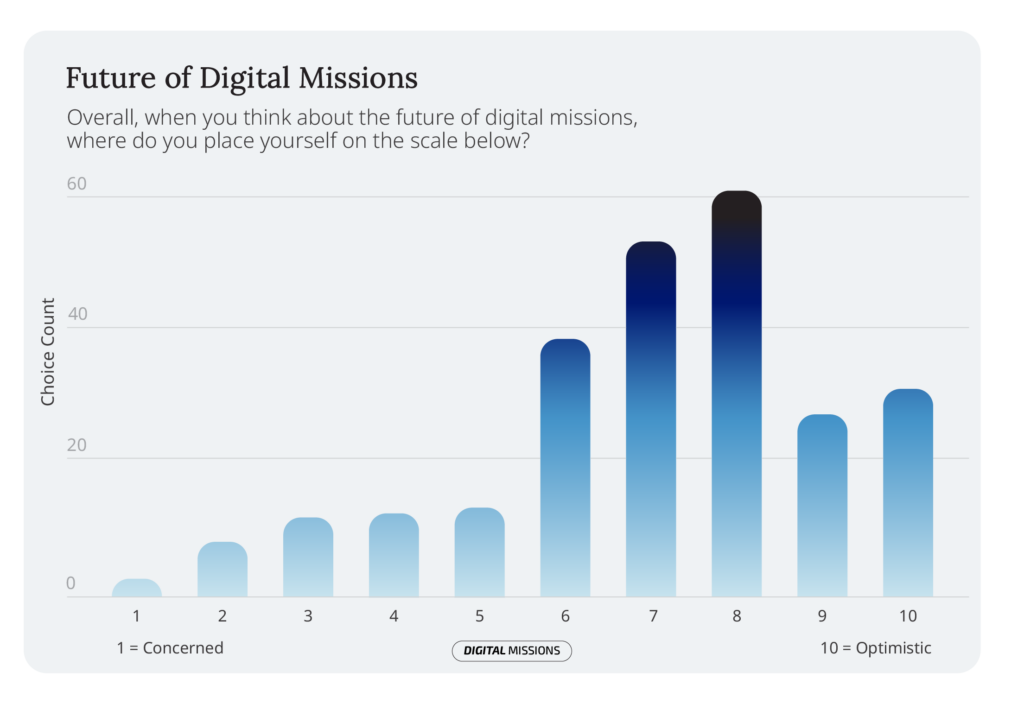
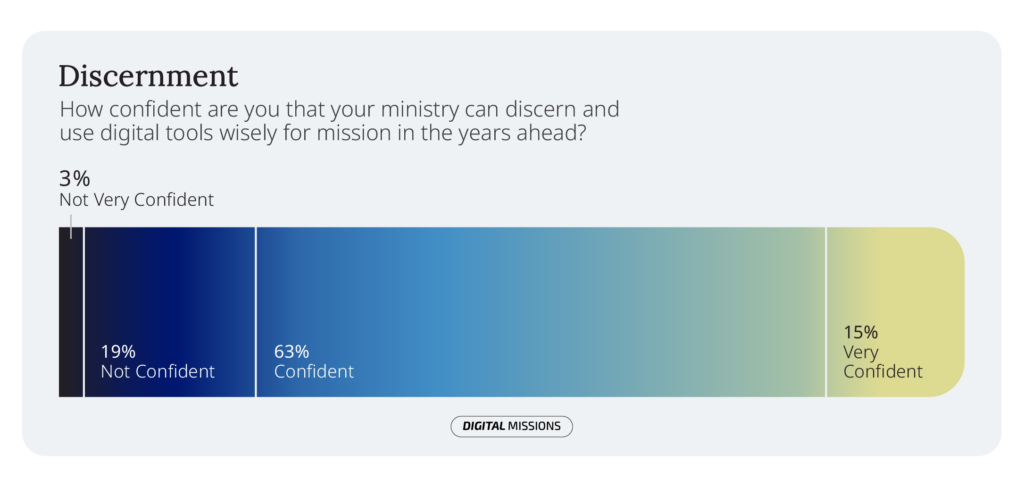
The leaders in this study do not approach the future with fear. About two-thirds place themselves between seven and ten on a 10-point scale of optimism. Nearly four in five express confidence that their ministries can discern and use digital tools wisely. These responses reflect a willingness to learn rather than retreat.
Hope does not mean that leaders believe every development will be beneficial. Their confidence is paired with caution. They recognize that digital tools can widen access and cross borders. They can support translation and make Christian resources available in places where physical ministry is difficult. The same tools can also distort relationships and weaken trust when they are used without wisdom.
This combination of hope & caution is a strength. It allows the church to explore new possibilities without treating innovation as an end in itself. The future of digital mission will require leaders who can recognize opportunity while remaining clear about what Christian mission is meant to produce.
WHAT LEADERS WANT TO PROTECT
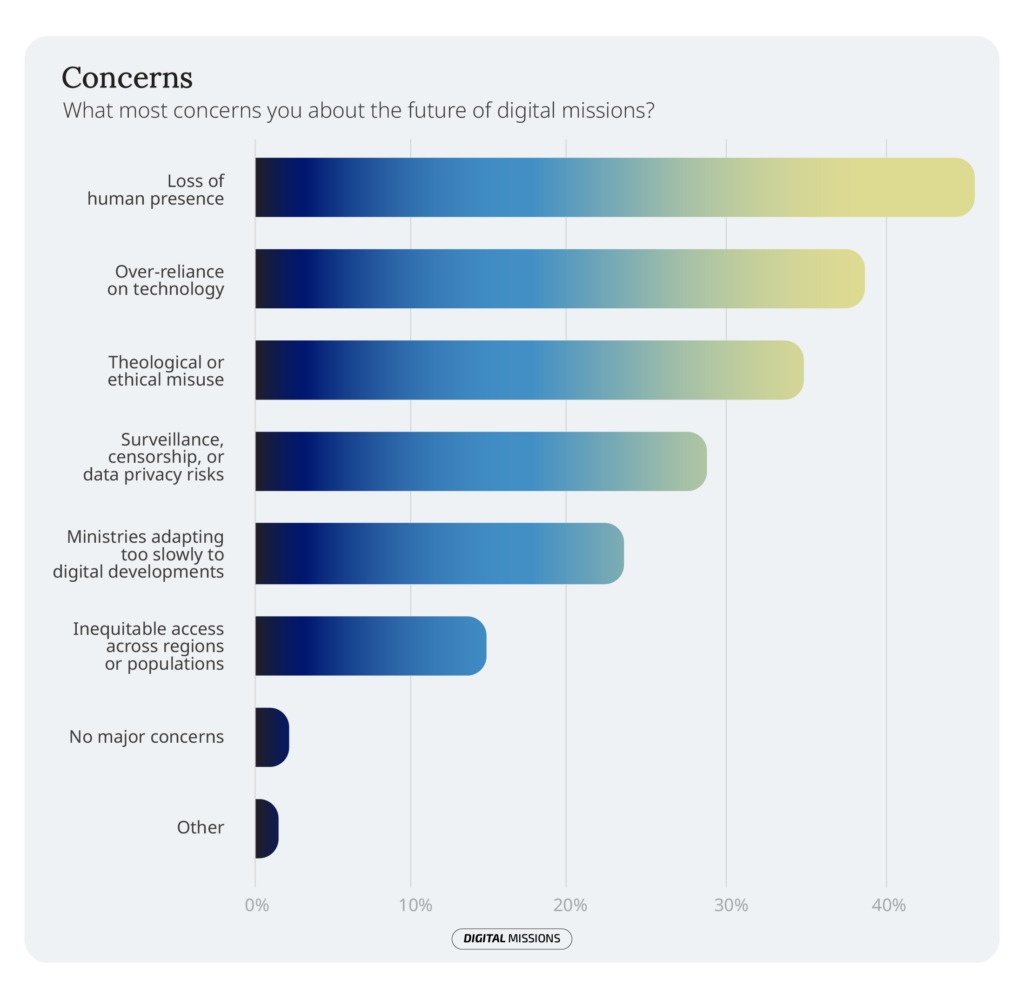
The leading concern is the loss of human presence. Nearly half of leaders identify it as one of their primary concerns. Many also worry about dependence on technology. Others focus on theological misuse or threats to privacy. These concerns reveal what leaders believe digital mission must protect as it develops.
The concerns expressed by leaders suggest that they understand mission as more than the movement of information. Their responses emphasize listening and human responsibility. They also point towards the importance of recognizing suffering and exercising judgment. Technology may support these practices, but respondents remain concerned about what may be lost when human presence becomes secondary.
These concerns become especially significant when people are vulnerable. A seeker may disclose fear or doubt in a private conversation. A believer in a restricted setting may face danger if personal information is exposed. A person asking a theological question may not know whether an answer is trustworthy. The responses show why leaders connect digital mission with the dignity and safety of the people being served.
DIGITAL AND EMBODIED BELONG TOGETHER
Participants responded to open ended questions with the repeated need to connect digital engagement to embodied Christian life. Leaders imagine personal follow-up and small groups. They want stronger links to local churches. They also call for contextual content that can lead people towards relationships within their own language and culture.
This does not reduce digital mission to a bridge that matters only until physical contact occurs. Digital relationships can be real and spiritually significant. For some people, they may remain the safest or most accessible form of Christian connection. Yet digital mission is strongest when it resists isolation. It should help people discover that following Christ involves belonging to a people as well as receiving a message.
The connection will look different across contexts. In one place, the next step may be a local church. Elsewhere, it may be a secure online group or a trusted believer nearby. The form should respond to local reality. The goal remains a life of discipleship shaped through relationship and shared Christian practice.
The future of digital mission will not be secured by technology alone. It will be shaped by Christians who use technology without surrendering truth, responsibility, or human presence.
WHOM ARE WE TRYING TO REACH?
Name the people beyond the ministry’s existing audience. Learn how they use digital spaces and what makes Christian engagement difficult for them.
WHAT RESPONSE ARE WE INVITING?
Clarify what should happen after someone encounters the content. Give people a realistic next step rather than leaving attention as the final outcome.
WHO WILL FOLLOW UP?
Prepare people to respond and follow up. Create a pathway towards discipleship and Christian community that fits the local context.
HOW WILL WE USE TECHNOLOGY RESPONSIBLY?
Place theological judgment and ethical safeguards around the work. Protect privacy and ensure that human review remains present.
WHAT MUST WE INVEST TO BECOME INTENTIONAL?
Identify the leadership and funding required. Build the capacity to learn from practice and sustain the work over time.
The findings describe a field whose importance is widely recognized but whose practice remains underdeveloped. Leaders see digital mission as an essential and growing part of Christian witness. They affirm the role of digital missionaries and call for greater investment. Yet many ministries remain without the leadership, training, funding, or strategy needed to pursue the work intentionally.
In the absence of this support, digital mission often becomes another name for communication. Churches stream services and share teaching. Ministries promote events and tell the story of their work. These activities serve important purposes, but they primarily reach people who are already connected. Digital presence alone does not fulfill the missional possibilities leaders see within digital culture.
The movement from digital presence to digital mission requires a Great Commission purpose. It asks ministries to look beyond their existing audiences and consider the people who remain beyond their current reach. It also asks what response is being invited. Digital mission is not only about making Christian content visible. It is about helping people encounter the gospel, respond in faith, and begin a pathway toward discipleship. This work requires more than acknowledgment. It requires investment and intentional strategy.
Ministries need equipped leaders who understand both mission and digital culture. They need resources that allow the work to develop beyond marketing and communications. They also need measures that help them learn whether digital engagement is leading to conversation, spiritual growth, and connection with Christian community.
The pathway remains deeply human. Digital tools can cross distance and create access, but people provide the care and follow-up that come next. They listen to questions and respond with care. They build trust and help others take meaningful steps toward Christ. Leaders therefore pair their enthusiasm for innovation with concern for truth, dignity, and human presence.
The opportunity before the church is not simply to become more active online. It is to carry the gospel faithfully into the places where people already live, search, question, and belong. The Great Commission remains unchanged, even as the ways we participate in it continue to develop within a digital world.

APPENDIX A: This study offers a focused view of how Christian leaders understand and practice digital mission. It should be read as a source of insight rather than a statistical portrait of the global church.
METHODOLOGY AND RESPONDENT PROFILE
PURPOSE AND APPROACH
Global Voices: Digital Missions gathered 329 responses from global Christian leaders between December 2025 and February 2026. The survey explored definitions and current activity alongside strategy, investment, artificial intelligence, and future outlook. It combined multiple-choice and rating questions with optional written responses about effective practices, barriers, hopes, and concerns.
Participation varied by question, so findings are based on the responses available for each item.
ANALYSIS
were not assigned percentages.
All 48 fields received a complete descriptive review. Response shares were calculated for each closed question, with multi-select results based on everyone who answered that item. Comparisons identified associations within the sample but did not establish causation.
All optional written responses were reviewed for recurring themes, including personal follow-up and local church connection. Qualitative themes were used to interpret the findings but were not assigned percentages.
RESPONDENT PROFILE
GEOGRAPHIC REACH
Respondents were from 70 countries. The largest country groups were the United States and India. The Philippines was followed by Nigeria and the United Kingdom. Canada and Japan were also among the larger groups.
The study therefore includes broad geographic reach, but it should not be read as evenly representative of every country or region.
ORGANIZATIONAL SECTOR
Parachurch, mission org. or NGO – 56%
Church – 27%
Theological education – 10%
Workplace – 7%
GENDER
Male – 77% Female – 23%
AGE
21-30 – 4%; 31-40 – 15%; 41-50 – 28%;
51-60 – 21%; 61-70 – 21%; 71+ – 12%
Ages are based on respondents’ reported birth years and their approximate age in 2026.
INTERPRETING THE FINDINGS
This engaged, non-random sample is not statistically generalizable to the global church. It offers insight into how a diverse group of leaders understands an emerging field, while some regions and demographic groups are more heavily represented than others.
Percentages are rounded for readability. Two contradictory records were excluded from the confidence chart.