

























Editor's Note
This article is based on the transcript of the speech given at the Opening Ceremony of the Lausanne Workplace Forum Africa & Middle East in Accra, Ghana on 7 August 2026. The Forum concluded with a collective recitation of The Accra Accord on Workplace Transformation.
The theme for this conference is Kingdom Impact in Every Sphere of Life: Workplace Engagement in Discipling Africa. But I’ve chosen a topic to work around this particular theme. And the topic I’ve chosen is The Church Called to Worship: A Biblical Foundation for Kingdom Impact in Every Sphere of Life. So what I’ll be doing is to kind of go through the word of God to bring some resolve that God wants us to be part of what is going on in the world. That is what God wants the church to be part of.
So the New Testament church is not a continuation of the life of Israel in the Old Testament. The church is something entirely new and distinct from anything that has preceded it or anything that will come after it. Yet Israel serves as a good pattern for our understanding of what the Church of God is and of the Church of God’s mission. The truth is that Israel was a type of the church. This is the reason why what they went through are examples for the church for all generations. The many references of the apostles and the writers of the New Testament to the Old Testament attest to this.
Worship involves all we do, and that there should be no dichotomy between what we call sacred and secular life of the believer.
I will attempt to lay a biblical foundation to underscore the fact that worship involves all we do, and that there should be no dichotomy between what we call sacred and secular life of the believer. The Christian believer should be the same everywhere in holiness and in sincere worship to the Lord. I will conclude by drawing our attention to the apparent secular-sacred divide in African Christianity in particular as a gap in our theology, in our administration of the gospel that needs to be filled.
Worship as Bowing and Serving
So, making reference to the Old Testament to lay this foundation, the church is called out to worship because Israel was drawn out of Egypt to worship. Exodus 4:23, “And I told you, ‘Let my son go, so he may worship me.’ But you refused to let him go; So I will kill your firstborn.” So let my son go and worship me. In fact, when later on Moses went to Pharaoh, he said, “God has asked us to go and worship him.” So Israel was drawn out of Egypt to worship. So we can say that all that they were doing in the wilderness was their act of worship to God.
At least that is what Pharaoh would think, because Pharaoh didn’t know their God. He had never seen them worship, but now they say that God wants us to worship him in the wilderness. So when he stood in his palace and he saw them in the wilderness, he would think that if they are bowing down, if they are playing football, he may think that that is how they worship their God, and Pharaoh would not be wrong at all. Worship is all we do. Pharaoh would not be wrong at all.
If Israel was called out of Egypt to worship their God, then the Church is also called out of the world to worship since Israel remains our pattern. So worship is a very vital religious rite that is increasingly losing its true meaning and value in the Christian church today. Many take worship only as a liturgical requirement, and then others also consider worship as a singing ministry that God has given some Christian artists whose performance we are to watch and enjoy. Worship also could be imagined to be the session or period of time in a church service where we are asked to just concentrate on God’s greatness and then adore him.
As a result of these misconceptions of worship, the dynamic glory of God in the Church and in the life of believers is lacking. There are two Hebrew words used in the Old Testament to refer to worship. The first one is shachah and the second one is avodah. Shachah is the main Hebrew word for worship. It literally means to bow down. Now, the second one, avodah, means to serve or to work as a slave without remuneration. Avodah connotes service to the world, to the rest of humanity, and to God. So shachah is to bow, avodah is to serve. Thus, worship involves not only bowing down as in praising or adoring or celebrating God, but also serving or doing some work for him.
Everywhere we are, we are before God, and we are expected to worship God in whatever we do.
Now, you can’t disconnect the two. It wouldn’t be worship at all. Let’s fancy that somebody meets me and then the person comes, he bows down and say, “Oh, chairman.” Now he’s worshiping me. And then I tell this fellow, “Pick this box and then place it in the back of this hall.” And the person says, “I will not do it.” Then I’ll ask the person, “Then what is the use for bowing to me? If you cannot serve me by working for me, then why are you adoring me?” You can’t separate the two. It doesn’t work like that. In fact, in the mind of God, there’s nothing like workplace and there’s nothing like the sanctuary. Everywhere we are, we are before God, and we are expected to worship God in whatever we do.
Old Testament Foundation
Now, let me give you some biblical support to what I’ve just said. Exodus 20:4-5, “Thou shall not make unto thee any graven image or any likeness of anything that is in heaven above or that is in earth beneath or that is in water under the earth. Thou shall not bow down thyself to them, nor serve them.” So you don’t have to bow down nor serve. So when we talk about worship, we are talking about adoration and service, both form worship.
Daniel 3:12, “There are certain Jews whom you have appointed over the affairs of the province of Babylon: Shadrach, Meshach, and Abednego. These men, O king, pay no attention to you; they do not serve your gods or worship the golden image that you have set up.”
So they neither serve, they neither avoda nor worship, shachah. Then verse 14 says that, “Nebuchadnezzar answered and said to them, “Is it true, O Shadrach, Meshach, and Abednego, that you do not serve my gods or worship the golden image that I have set up?” Verse 18 says that, “But if not, be it known to you, O king, that we will not serve your gods or worship the golden image that you have set up.”

How Jesus Redefined Worship
The main Hebrew word for worship, that is the shachah, to bow down, translates to proskuneó in Greek. This is the main word for worship, but it is very rare in the New Testament. You’ll find it somewhere in maybe Revelation or one or two in the Epistles. Revelation is where we see the angels bowing down to God. You find the appearance of this word. It is not there, and I’ll give you the reason why it is. This is because of the way Jesus practiced and taught worship during his earthly ministry. And most importantly, the effects of his substitutionary death on the cross that has redefined worship. His main statement on worship is found in John 4:20-26, in his encounter with the woman from Samaria, very wonderful encounter. “‘Our ancestors worshiped on this mountain, but you Jews claim that the place where we must worship is in Jerusalem.’ ‘Woman,’ Jesus replied, ‘believe me, a time is coming when you will worship the Father neither on this mountain nor in Jerusalem.’”
So the woman is making an argument that our father said we should worship here, and you people say you should worship in Jerusalem. Jesus will not argue or dispute that. All he said to the woman that a time is coming that we will neither worship on the mountain or in Jerusalem. Now, the following verses say, “‘You Samaritans worship what you do not know; we worship what we do know, for salvation is from the Jews. Yet a time is coming and has now come when the true worshipers will worship the Father in the Spirit and in truth, for they are the kind of worshipers the Father seeks.’ So at the time Jesus was talking to this woman, that time had not come.“
But the times, a time will come where God will seek true worshipers and they will worship him simply in Spirit and in truth. The next verse says that, “God is spirit.” So you cannot possibly confine God to any space. You can’t say they have to go to Jerusalem or the mountain because “God is spirit, and his worshipers must worship him in the spirit and in truth.” In verse 25, the woman said, “‘I know that Messiah’ (called Christ) ‘is coming. When he comes, he will explain everything to us.’” And for the first time, this woman forced Jesus to reveal himself that, “I am the Messiah.” Because what he’s telling this woman is the truth. But this woman is saying that we have heard, we have been taught by the rabbis that when the Messiah comes, you will eye on this difference.
But in the next verse, 26 “Jesus declared, ‘I, the one speaking to you—I am he.’” So what I’ve said is the truth. Don’t wait for any Messiah. A time is coming where the true worshipers will worship God in spirit and in truth. You shouldn’t say that this is workplace, this is chapel. It doesn’t work so far as Christ is concerned. A time is coming where the true worshipers will worship God in Spirit and in truth.
So where is the right place to worship or how do we worship the eternal God has been solved and taught by Christ in his encounter with this woman. And Jesus was categorical when he actually said, “I am he.”
Apart from his encounter with the Samaritan woman, he touched on true worship in other scriptures. For example, Matthew 15:8, “These people honor me with their lips, but their hearts are far from me.” The Pharisees spread their hands like Solomon did by the roadside. They had a form of godliness, but it was just a facade. These people worshiped me with their lips, but their heart is far away. Jesus did not have a problem with people adoring the Lord. His problem was the condition of their hearts, their deeds, which didn’t correspond with their posture of worship. That is the problem Jesus has. Your deeds should correspond with your posture of worship. Your service should correspond with your bowing down and your adoring. That is the problem that Jesus had.
So in the new covenant, worship as in bowing down and worship as in service are fused into one. Romans 12:1 says, “Therefore, I urge you, brothers and sisters, in view of God’s mercies, to offer your bodies as a living sacrifice, holy and pleasing to God – this is your true and proper worship.” But the big one is in Colossians 3:16 and 17. You see how the shahah and the avoda are fused together: “Let the message of Christ dwell among you richly as you teach and admonish one another with all wisdom through psalms, hymns, and songs from the Spirit. Sing to God with gratitude in your heart.” This one will be like adoring God, the shahah. But look at verse 17, “And whatever you do, whether in word or deed, do it all in the name of the Lord Jesus, giving thanks to God the Father through him.” So he’s saying that you can sing psalms, hymns, like adoring Him in terms of shahah. Then the next verse says, “Whatever you do.”
Three Essentials of Worship
So in the New Testament, worship is whatever you do. Now, what enforces this is Jesus’ death on the cross. In the Old Testament, there were three essentials of worship. Number one, you needed a priest. Number two, you needed a tabernacle. Number three, you needed sacrifice. For worship to be worship, you needed a priest, you needed a tabernacle, you needed a sacrifice. I want to say that by Jesus’s atoning death, he satisfied all these three essentials, and by so doing, he set them aside. Let’s quickly look at Christ as the priest.
Christ as the Priest
Christ as the priest Hebrews 7:11-12. 17-18, “If perfection could have been attained through the Levitical priesthood—and indeed the law given to the people established that priesthood—why was there still need for another priest to come, one in the order of Melchizedek, not in the order of Aaron?”
The Old Testament worship was God-instituted and God-initiated. In fact, it was inaugurated, and the priest was Aaron. But this chapter seven is saying that a new high priest has been introduced. For when the priesthood is changed, the law must be what? Changed also. And this new priest, he doesn’t even come from the tribe of Levi. He is coming from Judah. And God changed the priesthood on oath. Hebrews is saying that once the priesthood is changed, the order must be changed also. So the new priest, our high priest, is not Aaron. He is Christ Jesus, and he lives forever.
Once the priesthood has moved from the Levitical tribe into Judah, Hebrews is saying that the law must be changed. Verse 18 says this: “The former regulation is set aside because it was weak and useless.” So now that priesthood, which was led by Aaron in the Old Testament, the way the Israelites were involved, it has been set aside. A new high priest has been raised. He is Christ Jesus. He doesn’t die. He’s priest forever.
Christ as the Sacrifice
Now, Jesus and the sacrifices. Hebrews 10:5, “Therefore, when Christ came into the world, he said: ‘Sacrifice and offering you did not desire, but a body you prepared for me.’” So he came with a body. That is why he needed a woman’s womb, so he can have the body.
Verses nine and ten say that, “Then he said, ‘Here I am, I have come to do your will.”He sets aside the first to establish the second. And by that will, we have been made holy through the sacrifice of the body of Jesus Christ once for all.’” By coming in and giving us the sacrifice once for all, he set aside the old order.
Jesus as the Temple
Let’s look at Jesus the temple. Hebrews 8:1-2 say, “Now the main point of what we are saying is this: We do have such a high priest, who sat down at the right hand of the throne of the Majesty in heaven, and who serves in the sanctuary, the true tabernacle set up by the Lord, not by a mere human being.”
Jesus moves into a tabernacle in heaven that was not built by human hands. In fact, Acts chapter 17:24 says that, “God does not live in temples built by human hands.” Hebrews 9:11 says, “But when Christ came as high priest of the good things that are now already here, he went through the greater and more perfect tabernacle that is not made with human hands, that is to say, is not a part of this creation.” And so when we are worshiping, we are saying this is a temple. The new temple that Jesus went through is not part of this creation. In fact, it is a temple without barriers. That is why the curtain had to be rent into two, from the top to down.
So now when we are talking about temple, we are worshiping in temples without barrier. Just as he went straight to the presence of God. In worship, you are right before God, whether you are at the workplace or you are in a temple called a church. You are right there. Now, because we are who he is on this planet Earth, according to 1 John 4:17: “Herein is our love made perfect, that we may have boldness in the day of judgment: because as he is, so are we in this world.” So now Jesus is the priest, so are we. Peter says that we are priesthood. Jesus is the sacrifice, so are we.
Romans 12:1, “Therefore, I urge you, brothers and sisters, in view of God’s mercy, to offer your bodies as a living sacrifice, holy and pleasing to God—this is your true and proper worship.” Now Jesus is the temple, and the Bible said, “Don’t you know that you are the temple of God?” (1 Corinthians 3:16). Because as he is, so are we.
Let me also say that if we worship in such open temple and your body is a sacrifice, and you are the priest. Under normal circumstances, sacrifices will have to be brought to the temple; but you are the temple. The sacrifice supposed to be brought to the priest who supervise it; but you are the priest. And the sacrifice should be brought; and you are the sacrifice. So you are supervising your own worship. Wherever you are, you are actually worshiping. So there’s no dichotomy between sacred and secular. When you are going to work, you are the priest at your workplace, you are the sacrifice, and you are the temple. So worship God by what you do.

What’s Going Wrong in the African Church?
Now people ask, where is the church in Africa when Africa is so much bedeviled with evil and corruption? The problem is that the church in Africa is wrongly focused on itself. It must be focused in the world. Jesus told the disciples, “Go into the world.” So that is the focus of mission. It’s not on yourself.
When everything is about myself, anointing oil, this church is mine and all that, nothing will change in the world. You see, yeast has no value if it is not introduced into a medium. Once you introduce the yeast into the flour, it will work. Light is of no use if you don’t introduce it into the darkness. The place of the church is in the world. Jesus says that, “My prayer is not that you take them out of the world but that you protect them from the evil one.” So the church must be in the world, otherwise no transformation will happen. This is what the Protestants knew and they taught, and the people responded to it.
When we begin to teach like we are teaching, our parishioners will respond to it, because faith comes by hearing and hearing by the Word of God. Now, the Protestants taught their people.
When you wake up in the morning, don’t say that I’m a minister. My (Eric Nyamekye) job is not to go to where you work. I don’t qualify to be there. But my job is to wait for all of you on Sunday, teach you about the principles and the values of the Kingdom of God, and then you go apply them in your spheres. The lawyers will come to church, people from the media will come to church, the doctors will come, those from the education arena will come; they will all come. And then we give them the principles and the values of the Kingdom of God. It must work in the world. Then you go and transform your world. This is Christianity. This is how it should be. It must be ordinary and normal. That is why we are all priests.
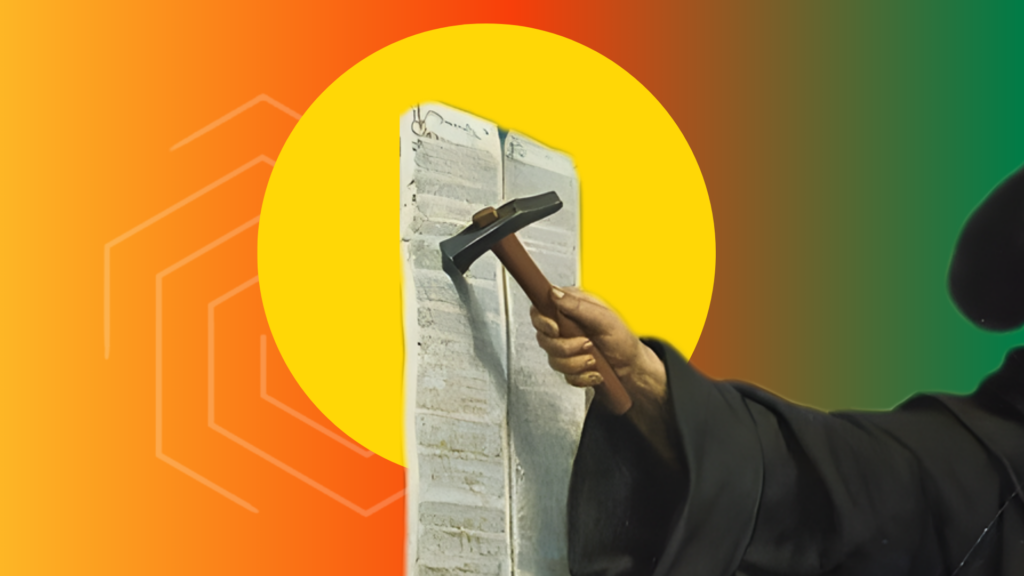
Lessons From the Protestant Reformation
Kingdom Virtues, Values and Morals in the World
The Protestants taught the priesthood of all believers. They believe that the principles of the kingdom virtues, values, and the morals of the Bible must not remain just in the church. They must be a part of the structure and the building blocks of society. And this was a great revelation they had. The teachings we have in church must be part of the building blocks of society. It works. After all, God created the Earth and he knows how to manage it. Now, if we are teaching ourself in the church and we are not applying it in the world, the world will not change.
Equality of All Before God
The Protestants talked about the equality. They talked about equality of all before God. The fact that I’m a minister does not mean that I’m greater than you, who is a lawyer or a teacher. No, we are all one. So do your work as a lawyer. I will do my work as a pastor. Do your work as an educationist, and that is all.

All Of Us Are Kingdom Workers
God has chosen the church as he chose Israel to reveal him to the world. The church is a space amongst the nations as they were, that through the church others will know the God of Israel, who is also our God. We need to rethink our faith and work connection. Our everyday ordinary life should not be divided or divorced from our faith.
Instead of wrestling with the dilemma of quitting your job to pursue what you call the full-time ministry, you should realize that your job could be your kingdom assignment and ministry. The unleashed servants are not stolen from the workplace. They are sent to the workplace to transform it with the values and principles of the Kingdom of God.
Life in the kingdom is not an escape from real life, but an engagement with real life so we can transform it. The kingdom carriers are woodworkers, they are bricklayers, they are plumbers, they are shopkeepers, they are lawyers, they are nurses, they are doctors, they are designers. All of us are kingdom workers.
So let us go into our spheres and do the work of the kingdom and transform the sphere. If the Lord is not Lord of all, then maybe he’s not Lord at all. The Bible says that the knowledge of God shall fill the earth as the waters cover the sea. And how does the water cover the sea? I want to suggest to you that the waters cover the sea fully. No dry place. So the kingdom must be everywhere. There must be no dry place. May the Lord bless us all.